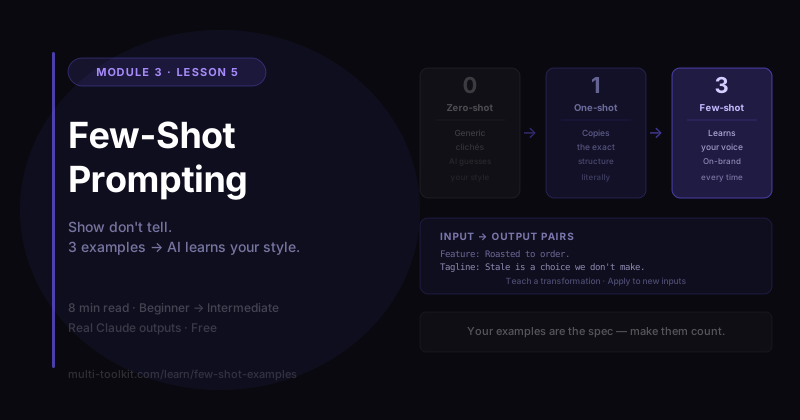
You'll learn: how to teach the AI a style, format, or transformation by showing it 1–3 examples — and how to pick examples that work. You'll walk away with: the Few-Shot Pattern Pack — the input→output template + the 4 rules for good examples. Level: Beginner → Intermediate · Prereq: Turn a weak prompt into an expert one
Every example below is a real, unedited Claude (Sonnet 4.6) response from June 2026. Same task — write taglines for Brew Lab — with a different number of examples each time.
1. The Problem
Some things are almost impossible to describe but easy to show. Try explaining your brand's "voice" in words: "smart but not stuffy, witty but not corny, confident but not salesy." The AI will nod and still give you something generic.
The fix is few-shot prompting: instead of describing what you want, you show the AI a few examples and let it copy the pattern. It's the difference between telling someone "be funny" and handing them three jokes that landed.
Let's watch one task — writing taglines — go from generic to on-brand as we add examples.
2. Beginner Example — Zero-Shot vs One-Shot
Zero-shot (no examples)
Write 5 short product taglines (under 12 words each) for Brew Lab, an online coffee brand.
Real output:
- Precision roasted. Perfectly brewed. Science in every sip.
- Great coffee isn't luck — it's chemistry.
- From bean to breakthrough, brewed for the bold.
Not bad… but generic. "Science in every sip," "brewed for the bold" — the kind of lines a hundred brands could use. With nothing to copy, the AI reaches for clichés.
One-shot (a single example)
Here's an example of our tagline style:
"Some coffees taste like coffee. This one tastes like somewhere."

Write 5 more Brew Lab taglines in this same style (under 12 words each).
Real output:
- "Some mornings happen to you. This one you chose."
- "Some cups wake you up. This one slows you down."
- "Some coffee fills the mug. This one fills the room."
Whoa — it nailed the vibe. But notice something: every single line copied the exact structure of the one example: "Some ___. This one ___."
That's the key lesson about one-shot: the AI treats your one example as the rule. Sometimes that's perfect (you want that exact template). But if you only meant "this general vibe," one example boxes it in.
🔑 One example = one pattern. The AI assumes the structure of your single example is the format you want. Powerful, but narrow.
3. Intermediate Example — Few-Shot (3 Examples)
Now we give three examples — deliberately using different sentence structures:
Here are examples of our tagline style:
- "Some coffees taste like coffee. This one tastes like somewhere."
- "We roast after you order. Stale is a choice we don't make."
- "Tasting notes aren't marketing. They're a lab report you can drink."

Write 5 more Brew Lab taglines in this same style (under 12 words each).
Real output:
- "Freshness isn't a feature. It's the whole argument."
- "Most roasters guess. We measure, then we roast."
- "The bag tells you when. We tell you why."
- "Good coffee asks questions. Ours expects answers."
Now that's on-brand — and it's varied. Because the three examples used different structures, the AI stopped copying one template and instead learned the underlying voice: contrarian, science-y, confident. The output is natural, not formulaic.
🔑 Vary your examples to teach a style; keep them uniform to teach a format. Three varied examples → the AI generalizes the vibe. Three identical-structure examples → it locks the template.
4. Advanced Example — Input→Output Pairs (the power move)
The most powerful form of few-shot isn't "here are some examples" — it's showing the AI a transformation as input→output pairs. It learns the mapping and applies it to new inputs:
Turn each plain coffee feature into a Brew Lab tagline. Follow these examples:

Feature: Roasted to order, ships in 48 hours.
Tagline: We roast after you order. Stale is a choice we don't make.

Feature: Single-origin Ethiopian, light roast.
Tagline: One farm. One bean. Nothing hiding in the blend.

Now do these:
Feature: We publish the altitude, process, and roast date on every bag.
Feature: Light roasts that taste like fruit, not char.
Real output:
"Every bag tells you exactly what's inside. Because transparency shouldn't stop at the label." "Light roast done right. Bright, fruity, and proof that coffee doesn't have to taste like a campfire."
It learned the feature → tagline transformation and applied it to brand-new features. This is how you teach the AI to do repeatable work — classify tickets, format data, rewrite in a house style, turn notes into summaries — all by example.
🔑 Input→output pairs teach a transformation. Show 2–3
input → outputexamples and the AI applies the same mapping to new inputs.
5. ⚠️ The Catch: The AI Copies *Everything* in Your Examples
Look closely at #4. The new taglines are good — but they're noticeably longer and wordier than the short, punchy examples we gave. Why?
Because the AI copies every pattern it detects in your examples — and infers rules you didn't state. Our examples happened to be short, but we never said "keep them short," so it didn't treat brevity as a rule. It matched the transformation and the voice, but let the length drift.
This is the golden rule of few-shot:
- Your examples are the spec. Whatever they have in common — length, tone, structure, formatting — the AI will treat as the target.
- Make examples consistent on the things that matter.
- Add an explicit constraint for anything your examples don't reliably encode ("…each under 10 words"). Examples + a constraint beat either alone. (More on this in Output Formatting.)
6. Common Mistakes
| Mistake | Why it happens | The fix |
|---|---|---|
| Describing the style instead of showing it | We default to instructions | Paste 1–3 real examples |
| Using one example when you wanted variety | The AI copies that one template exactly | Give 3 varied examples to teach the vibe |
| Inconsistent examples | We grab whatever's handy | Make examples consistent on tone/length/format |
| Assuming the AI infers the implicit rule | Examples don't state everything | Add an explicit constraint (length, count, format) |
| Examples that contradict each other | Mixed messages | Every example should be one you'd happily accept |
7. Templates (Your Take-Home)
Few-shot for style:
Here are examples of the style I want:
- [example 1]
- [example 2]
- [example 3]   ← vary the structure; keep the tone consistent
Now produce [N] more in this same style. [+ any explicit constraint]
Few-shot as input→output (transformation):
[Describe the task]. Follow these examples:

Input: [example input 1]
Output: [example output 1]

Input: [example input 2]
Output: [example output 2]

Now do these:
Input: [new input]
📥 Download the Few-Shot Pattern Pack (free) — both templates, how many examples to use, and the 4 rules for good examples. (Email opt-in.)
8. Your Challenge
Do this now: pick something with a style or format you want repeated (your email sign-offs, a caption style, a way you label tasks). Give the AI 3 examples, then ask for 5 more. Then add one explicit constraint and compare.
You did it right if: the output matches your examples closely enough to use — and you can name which property you had to pin down with a constraint.
Keep going: ← Pillar: Upgrade a Prompt · Siblings: Role Prompting · Context Prompting · Output Formatting · Start the Starter Course →