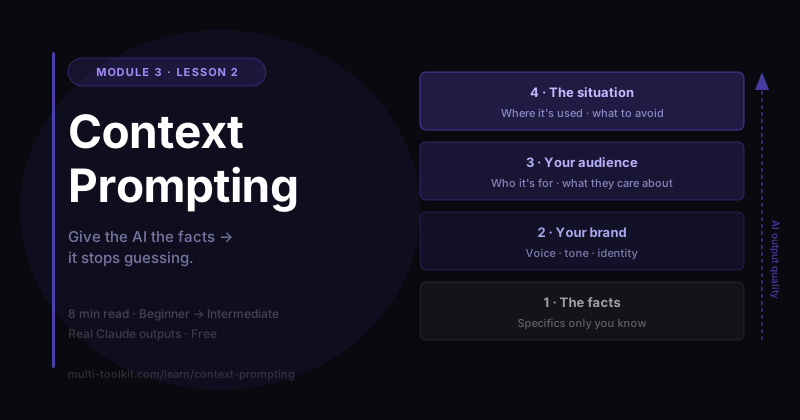
You'll learn: how to give the AI the right context — facts, brand, audience, and situation — so it stops guessing and gives you tailored answers. You'll walk away with: the Context Checklist — the 6 kinds of context worth adding. Level: Beginner → Intermediate · Prereq: Turn a weak prompt into an expert one · Pairs with Role Prompting
Every example below is a real, unedited Claude (Sonnet 4.6) response from June 2026. We ask for the same thing — "write a product description for our coffee" — four times, adding more context each run. Watch it lock in.
1. The Problem
When an AI answer feels generic — like it "could be about anyone" — the problem usually isn't the AI. It's that your prompt is context-starved. You know your product, your brand, and your customer. The AI knows none of it unless you say so.
Give it nothing and it does one of two things: asks you a pile of questions, or guesses — and its guesses are the bland average of everything it's ever read. Give it the right facts and it produces something that could only be about you.
Let's prove it with one task and a growing pile of context. Our brand: Brew Lab (the coffee company from the role-prompting lesson).
2. Beginner Example — No Context vs Some Context
No context
Write a product description for our coffee.
What happened: Claude couldn't proceed, so it asked questions (type? flavor? selling point?). After basic answers it wrote:
"Wake Up to Something Exceptional" — "our whole bean dark roast delivers a coffee experience that's as uncompromising as you are… Roasted to perfection… This is coffee, elevated."
Two problems jump out:
- It guessed a dark roast — the opposite of our actual light roast. With no facts, it filled the blank wrong.
- It reached straight for generic clichés — "exceptional," "premium," "roasted to perfection." The stuff every coffee bag already says.
Add the facts
Context: the coffee is an Ethiopian single-origin, light roast, with tasting notes
of blueberry, citrus, and a tea-like finish. Roasted to order and shipped within 48 hours.

Write a product description for our coffee.
What happened: no questions, and it's accurate now:
"Ethiopian Single-Origin Light Roast — Some coffees taste like coffee. This one tastes like somewhere."* … bright blueberry, a citrus lift, a clean tea-like finish; "roasted to order and in your hands within 48 hours."
Just by giving it the facts, the guessing stopped. Right roast, right notes, real freshness angle.
🔑 Context block #1 — the facts. The specifics only you know (what it is, the real details). This alone fixes most "generic AI."
3. Intermediate Example — Add Brand + Audience
Same task. Now we tell it who we are and who we're talking to:
Context:
- [the same product facts as above]
- Our brand, Brew Lab, is for curious home brewers who want to understand their coffee.
  Our voice is smart, transparent, and a little science-y — we share tasting notes and sourcing openly.
- Our customers are comparing us against other specialty online roasters.

Write a product description for our coffee.
What happened: it announced "here's a product description written in Brew Lab's voice" and delivered:
"Some coffees taste like coffee. This one tastes like an argument for what coffee can be." Then it explained the why: "Yirgacheffe sits above 1,800 meters, where slow-developing cherries concentrate their sugars…" — structured tasting notes, and even a brew tip ("start with a 1:15 ratio, water around 90°C").
See the shift? Brand context gave it a voice (curious, science-y). Audience context (home brewers, comparing roasters) made it explain the why and add a brew tip — exactly what that reader values.
🔑 Context blocks #2 & #3 — who you are (brand/voice) and who it's for (audience). Facts make it accurate; brand and audience make it yours and relevant.
4. Advanced Example — Add the Situation
The last layer is the most overlooked: where this will be used and what the reader is doing when they see it.
Context:
- [product facts + brand + audience as above]
- This goes on the product page. Most visitors arrive from Google searching "best light
  roast coffee" and are comparing 2–3 options. They care most about freshness and clear
  flavor. Avoid generic adjectives like "premium" and "high quality."

Write a product description for our coffee.
What happened: it restructured the whole thing around the buying moment:
"…this single-origin is about clarity, not intensity." Sections: What it tastes like · Why freshness matters here ("Light roasts fade fast… roasted after you order… so you're brewing at peak, not working through someone else's warehouse stock") · Good for (pour-over, filter) · From the source. Closer: "If you're comparing this against other light roasts: the difference is how transparent the flavor is. Nothing hidden, nothing added."
It led with freshness and clarity (what we said the reader cares about), spoke directly to the comparison shopper, and obeyed the constraint — not a single "premium" or "high quality." That's context doing the thinking.
🔑 Context block #4 — the situation. Where it'll be read, what the reader is doing, and what to avoid. This is what turns a good answer into the right answer.
5. ⚠️ A Real Warning: Context Invites the AI to Fill Gaps
Here's something the screenshots reveal that most tutorials won't tell you. As we added context, Claude also added facts we never gave it — it called the coffee "Yirgacheffe," set it at "1,800 meters," and labeled the process "natural." All plausible. None of it was in our prompt.
This is the flip side of context: the more you set the scene, the more confidently the AI fills in the blanks — sometimes with details that sound authoritative but aren't true. (This is how hallucinations sneak into great-looking copy.)
The fix is simple:
- Pin down the facts you care about in your context, so the AI doesn't invent them.
- Verify anything it adds before you publish — especially names, numbers, and claims.
Context is powerful because it lets the AI reason about your situation. That same power means you stay the fact-checker.
6. Common Mistakes
| Mistake | Why it happens | The fix |
|---|---|---|
| Giving no context | We assume the AI "knows what we mean" | Add the facts — the AI knows nothing about you by default |
| Only giving facts, no audience | We describe the thing, not the reader | Add who it's for and where they'll see it |
| A wall of unstructured context | We brain-dump | Use labeled lines (facts / brand / audience / situation) so it's parseable |
| Trusting AI-added details | Rich context makes output sound authoritative | Verify names, numbers, and claims it introduces |
| Vague situation | We forget the "where/when" | Say where it'll be used and what the reader is doing |
7. Templates (Your Take-Home)
The context block — stack what's relevant:
Context:
- The facts: [what it is, the real specifics]
- Who I am: [brand / voice]
- Who it's for: [audience + what they care about]
- The situation: [where it'll be used, what the reader is doing, what to avoid]

[Your task]
📥 Download the Context Checklist (free) — the 6 kinds of context worth adding, with examples. (Email opt-in.)
Pairs with the rest: add a role (who the AI is) on top of context (the situation) — see the pillar for the full stack.
8. Your Challenge
Do this now: pick a task (a bio, a product blurb, an email). Run it with no context, then again with a context block covering the facts, who it's for, and where it'll be used.
You did it right if: the second answer could only be about your specific thing — and you caught at least one detail the AI tried to add that you needed to correct.
Keep going: ← Pillar: Upgrade a Prompt · Siblings: Role Prompting · Few-Shot Examples · Output Formatting