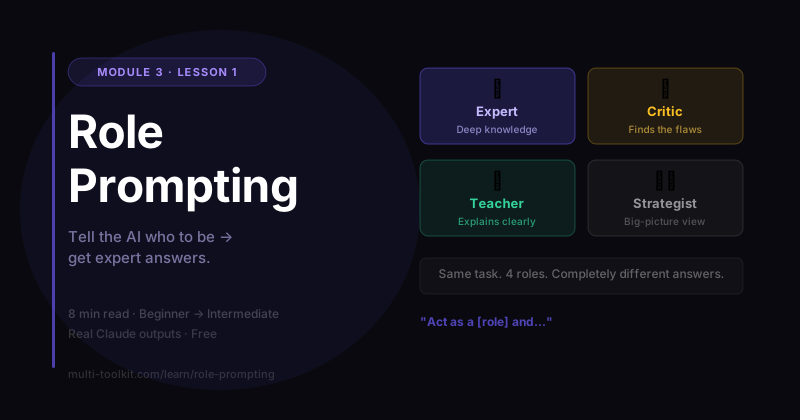
You'll learn: how to use role prompting to steer the AI's expertise, tone, and perspective — and how to pick the right role for the job. You'll walk away with: the Role Prompting Library — 12 ready-to-use roles + the role-stacking formula. Level: Beginner → Intermediate · Prereq: Turn a weak prompt into an expert one
Every example below is a real, unedited Claude (Sonnet 4.6) response from June 2026. We give the AI the same task and the same text four times — and change only the role. Watch the answer transform.
1. The Problem
When you ask AI a question with no role, you get the average of everything it knows — a safe, competent, generic answer. Fine, but rarely sharp.
Here's the thing most people miss: the AI can be a conversion copywriter, a brand strategist, or your most skeptical customer — but only if you tell it which one. A single line, "Act as a ___," swaps the lens the AI looks through. Same question, completely different (and far more useful) answer.
Let's prove it. We'll ask the AI to critique one weak "About Us" paragraph — and only change who it's pretending to be.
Our test paragraph (kept identical in all four runs): "About Us: We are Brew Lab, a small coffee company. We sell coffee beans online. Our coffee is high quality and we care about our customers. We started in 2021 because we love coffee. Try our beans today."
2. Beginner Example — No Role vs a Role
No role (the baseline)
Give me feedback on this About Us paragraph for my website:
[Brew Lab paragraph]
Real answer (trimmed):
What's working: it's clear and readable, no jargon. What's missing: "the paragraph tells instead of shows. 'High quality' and 'we care about our customers' are claims every company makes, so they land as filler."
It's fine. Balanced, sensible, the feedback a smart generalist would give. But it doesn't dig in any particular direction — because we didn't point it anywhere.
Add one role
Act as a conversion copywriter who specializes in small e-commerce brands.
Give me feedback on this About Us paragraph, focused on turning visitors into buyers:
[Brew Lab paragraph]
Real answer (trimmed):
"The core problem: it's all about you, not the reader." … "every sentence starts with 'we.' That's a trust-killer." Weak CTA: "'Try our beans today' — 'try' implies risk. Order, discover, get your first bag — these are more decisive." Rewrite: "Most coffee you find online was roasted weeks ago and warehoused longer. We built Brew Lab in 2021 because we were tired of paying premium prices for stale beans. Every bag ships within 48 hours of roasting…"
See the difference? The role made the AI prioritize like a copywriter — buyer psychology, the "we vs you" problem, the call to action. That's a lens the no-role answer never put on.
🔑 A role is a lens. It doesn't just change tone — it changes which problems the AI notices and the vocabulary it uses to fix them.
3. Intermediate Example — Different Role, Different Expert
Keep the exact same paragraph. Now ask a brand strategist:
Act as a brand strategist.
Review this About Us paragraph for what it says about our brand identity, voice,
and positioning — and how to make Brew Lab more distinctive:
[Brew Lab paragraph]
Real answer (trimmed):
"The name Brew Lab is actually intriguing (it implies science, craft, experimentation), but the copy completely ignores what that name promises." Strategic territory: "the coffee brand for people who treat brewing as a craft they want to understand and improve." Brand pillars: Curiosity over ceremony · Transparency as trust · The customer as the brewer. "The biggest shift is from describing the company to inviting the customer into a point of view."
Completely different feedback — and notice it caught something the copywriter didn't: the name itself is a strategic asset. The copywriter optimized the sale; the strategist optimized the identity. Neither is wrong — they're different jobs, so you pick the role that matches your job.
🔑 Choose the role from the job to be done. Want more sales? Copywriter. Want to stand out? Strategist. Want to know if it even lands? …keep reading.
4. Advanced Example — Persona Roles (simulate your audience)
Expert roles borrow a skill. The most underused trick is a persona role — make the AI become your audience and react honestly. Same paragraph, but now:
Act as a skeptical first-time visitor to this website who has never heard of this brand.
Read this About Us paragraph and tell me: what makes you trust or doubt the business,
and what questions are you left with?
[Brew Lab paragraph]
Real answer (trimmed):
*"My gut feeling: Meh. Not convinced."* … "reads like it was written in five minutes." What makes me doubt: "Zero specifics… No social proof whatsoever — no reviews, ratings, or even a quote from one happy buyer… 'We care about our customers' is a red flag phrase." Questions I'm left with: "Why should I buy from you specifically? … Where do your beans come from? … Are you still even operating?" "I'd probably bounce and find someone with more substance."
This is gold. Instead of expert advice about your reader, you got your reader's actual reaction — the doubts, the missing trust signals, the exact questions that make them leave. That's customer research in 10 seconds.
🔑 Two kinds of roles: expert roles ("act as a copywriter") borrow a skillset; persona roles ("act as a skeptical customer") simulate your audience. Use both.
The big takeaway: four runs, one paragraph, four genuinely useful — and different — answers. For a real decision, run several roles and you get a 360° review for free.
5. Real Use Cases
- Business: "Act as a CFO" to pressure-test a budget; "act as our toughest customer" to find objections before they do.
- Student: "Act as a patient tutor who uses analogies" to learn; "act as a strict examiner" to get graded.
- Creator: "Act as a YouTube strategist" for titles; "act as a first-time viewer" to test if a hook lands.
- Developer: "Act as a senior engineer doing code review"; "act as a security auditor" to hunt for holes.
6. Common Mistakes
| Mistake | Why it happens | The fix |
|---|---|---|
| No role at all | We treat AI like a search box | Add "Act as a ___" — instant lens + expertise |
| Vague role ("act as an expert") | We think any title helps | Be specific: "a conversion copywriter for small e-commerce brands" |
| Fake authority ("act as the world's #1…") | We think hype = quality | Skip the superlatives; specificity beats bravado |
| One role for a big decision | We stop at the first answer | Run 2–3 roles (incl. a persona) for a 360° view |
| Forgetting persona roles | We only think of expert roles | "Act as my customer/skeptic/boss" simulates the real audience |
7. Templates (Your Take-Home)
The role prompt formula:
Act as [SPECIFIC ROLE — skillset + niche + (optional) attitude].
[Your task], focused on [what this role should optimize for].
[Your content]
Role stacking — combine with the pillar's other blocks:
Act as [ROLE].
Context: [situation + facts].
Goal: [the one outcome].
[Task + any constraints / format].
Role sets who; Context/Goal/Constraints set what. (See the pillar: Upgrade a Prompt.)
📥 Download the Role Prompting Library (free) — 12 high-value expert and persona roles with when-to-use, plus the stacking formula. (Email opt-in.)
8. Your Challenge
Do this now: take one thing you've written (an email, a bio, a product description). Ask AI for feedback three times with three different roles — one expert role, one persona role (your target reader), and your own choice.
You did it right if: the three answers genuinely disagree on what to fix — and you can decide which role's advice to follow based on your actual goal.
Keep going: ← Pillar: Upgrade a Prompt · Siblings: Context Prompting · Few-Shot Examples · Output Formatting · Start the Starter Course →