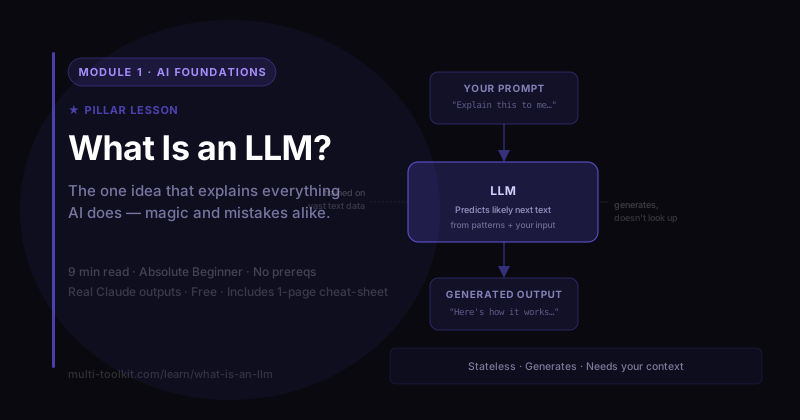
You'll learn: the single idea behind how ChatGPT, Claude, and Gemini work — and why it explains their magic and their mistakes. You'll walk away with: the LLM Mental Model — a one-page picture you can keep in your head forever. Level: Absolute beginner · Prereq: none. This is the real starting point.
The examples below are real Claude (Sonnet 4.6) responses from June 2026 — including two that surprised us and made the picture clearer.
1. The Problem
Most people use AI without any idea of what's happening under the hood — so they're constantly surprised. It gives a brilliant answer, then confidently states something false. It "remembers" you one minute and seems clueless the next. Without a mental model, AI feels like magic — and you can't reason about magic.
The good news: you don't need math or computer science. One simple idea explains almost everything AI does. Get it, and the rest of this course clicks into place.
2. The One Idea
An LLM (Large Language Model) predicts the next most likely piece of text, based on patterns it learned from huge amounts of writing — and on whatever you put in front of it.
That's it. It's not looking up answers in a database. It's not "thinking" like a person. It read an enormous amount of text during training, learned the patterns of how language fits together, and now — given some words — it generates the words that most plausibly come next.
"LLM" just means Large (trained on a lot) Language (text) Model (a pattern-prediction system). Everything else follows from "predicts likely text."
Let's watch that idea show up three times.
3. It *Generates*, It Doesn't *Look Up*
I asked Claude to finish one sentence five ways:
Finish this sentence in 5 different ways:
"The single most important habit for success is..."
It produced five different, equally plausible endings — consistency, protecting your attention, reflecting and course-correcting, doing the hard thing first, investing in yourself.
There's no single "correct" answer stored somewhere that it retrieved. It generated five likely continuations. That's the whole engine: given your text, produce probable next text. (It's also why you can get a different answer each time — it's sampling from possibilities, not reading one fixed record.)
🔑 AI generates plausible text — it doesn't fetch facts from a database.
4. So It Can Be Confidently Wrong (Hallucinations)
If the engine produces plausible text, it can produce text that sounds right but isn't. I tested it with a book that doesn't exist:
In 3–4 sentences, summarize the plot of the 1994 novel
"The Cartographer's Silence" by Mara Velline.
Here's the encouraging part — modern Claude caught it:
"I can't find any record of this title or author… fabricating a plot summary for a book I don't recognize would be a hallucination — confidently invented details dressed up as fact."
A few years ago, most models would have happily invented a plot. Today's models are trained to resist — and Claude even named the phenomenon. But it's not foolproof. The underlying engine still predicts plausible text, so on a less obvious question it can state a confident falsehood. The rule that follows from the one idea:
🔑 "Sounds right" is not "is right." Verify anything that matters. (We go deep on this in the Hallucinations lesson.)
5. "But It Remembered Me!" — The Model vs the App
Here's the demo that flipped our assumption. In a brand-new chat I asked, "What's my name, and what did we talk about yesterday?" — and Claude knew my name and recalled the previous day's project.
Wait — didn't we just say the model predicts text with no memory? Yes. So I asked it to explain, and its answer is the key to understanding every AI product:
"Each conversation, I start fresh. The underlying AI model… has no memory whatsoever between sessions."
So how did it remember? Through features built around the model:
- Memory summaries — the system pulls key facts from your past chats and injects them into the conversation at the start.
- Conversation search — it can look up past transcripts on demand.
Its own analogy nails it:
"I'm like a doctor who has no personal memory, but walks into each appointment having read your chart. The chart is assembled by the system, not remembered by me."
This is the distinction that confuses almost everyone:
- The raw model = a stateless next-text predictor. No memory of you. No live internet. Just pattern prediction.
- The app (Claude, ChatGPT, Gemini) = the model plus layers — memory, web search, file uploads, tools.
When AI "remembers you," "looks something up online," or "reads your PDF," that's the app, not the model. Knowing which is which is how you stop being surprised.
🔑 The model predicts text and is stateless. Memory, search, and tools are the app wrapped around it.
6. What This Means for You
Everything practical flows from the one idea:
| Because the model… | …you should |
|---|---|
| generates likely text, not stored facts | verify important claims (names, numbers, quotes) |
| only works with what's in front of it | give it the context it needs (the whole point of Module 3) |
| is stateless on its own | not assume it "knows you" — rely on the app's memory features, and check them |
| has a training cutoff | use web search for anything recent, and check dates |
| sounds equally confident when right or wrong | treat tone as no evidence of truth |
7. Common Misconceptions
| Myth | Reality |
|---|---|
| "AI is a search engine / database" | It generates text from patterns; it doesn't retrieve records |
| "If it sounds confident, it's true" | Confidence is just fluent text — verify |
| "It understands me like a person" | It predicts likely responses; understanding is an illusion of good prediction |
| "It remembers everything I tell it" | The model doesn't; the app's memory feature stores some things — imperfectly |
| "It knows what's happening today" | Only via web search; its built-in knowledge stops at a training cutoff |
8. Your Mental Model (keep this)
An LLM predicts the next likely text from patterns + your input. It generates (so it can be wrong), and the core model is stateless (so memory and search come from the app).
That one sentence explains hallucinations, why context matters, why prompting works, and why two apps using the "same AI" behave differently. The rest of this course is just putting it to work.
📥 Download the LLM Mental Model (1-page, free) — the one idea + its consequences, ready to pin up. (Email opt-in.)
9. Your Challenge
Do this now, in your AI of choice:
- Ask it to summarize a book or paper you invent on the spot. Watch whether it catches the trap or makes something up.
- In a fresh chat, ask "what do you know about me?" — and notice what comes from a memory feature vs what it doesn't actually know.
You did it right if: you can point to one moment where it generated (not retrieved), and explain whether any "memory" came from the model or the app.
Keep going: Next in Foundations → AI Hallucinations · Context Windows · AI Memory & Projects · Then put it to work → Prompt Engineering