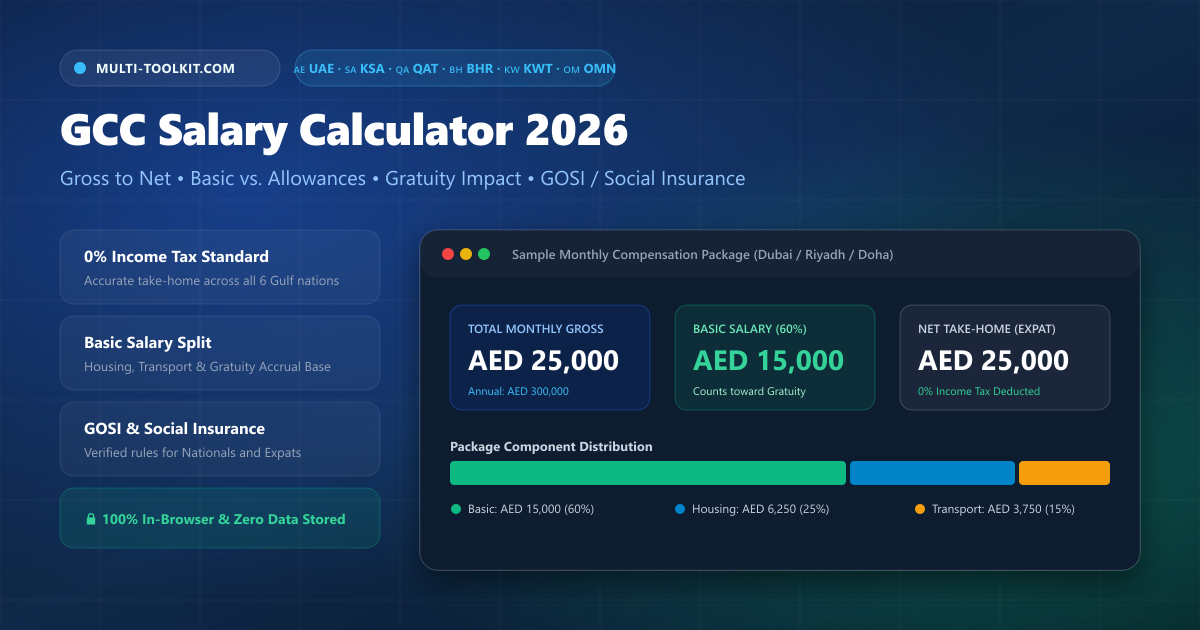
When professionals relocate to the Gulf Cooperation Council (GCC)—or negotiate a new employment contract in Dubai, Riyadh, Doha, or Manama—the promise of a 0% personal income tax package is often the primary draw. Yet if you plug a Gulf job offer into standard international salary calculators, you will receive misleading tax deductions, phantom withholdings, and zero insight into how your earnings actually work.
In the Gulf, calculating your true compensation is not about income tax brackets. It is about understanding compensation packaging: the crucial legal split between your Basic Salary and your Allowances (Housing, Transport, Utilities).
Because statutory end-of-service gratuity, overtime pay, and loan eligibility are calculated almost exclusively on your basic wage, an offer with an unfavorable breakdown can quietly cost you tens of thousands of dollars upon departure. The Multi-Toolkit GCC Salary Calculator is a verified, region-specific gcc salary calculator designed to compute your exact take-home pay, model your allowance distribution, and forecast your future gratuity entitlement.
The hidden traps of Western salary calculators in the GCC
1. Irrelevant tax withholdings & deductions
Generic calculators automatically subtract 15% to 35% in federal, state, or municipal income taxes. Across all six GCC nations (UAE, Saudi Arabia, Qatar, Bahrain, Kuwait, and Oman), expatriate employees pay 0% personal income tax. Net salary for an expat is practically 100% of their gross agreed package.
2. Ignoring the critical Basic vs. Allowance split
In Western employment contracts, compensation is typically a single consolidated figure. In the GCC, employment contracts split total compensation into distinct components:
- Basic Salary: Typically 50% to 67% (standard regional benchmark is ~60%).
- Housing Allowance: Usually 25% to 30%.
- Transport Allowance: Usually 10% to 15%.
- Other Allowances: Mobile, education, or utility stipends.
If a company offers you AED 30,000 per month structured as AED 10,000 basic + AED 20,000 allowances, your take-home pay today is identical to an AED 20,000 basic + AED 10,000 allowance split. However, when you leave the company, your end-of-service gratuity payout will be 50% lower.
3. Confusing social insurance (GOSI / SIO / PASI) rules
Many employees are unsure whether social insurance applies to them. In Saudi Arabia, the UAE, Qatar, Kuwait, Bahrain, and Oman, mandatory state pension systems (such as GOSI in Saudi Arabia or GPSSA in the UAE) apply strictly to GCC national citizens, not expatriates. Calculators that do not distinguish between citizen and expat status produce incorrect net pay figures.
How the Multi-Toolkit GCC Salary Calculator works
The Multi-Toolkit Salary Calculator is built for Gulf compensation structures:
- GCC-Specific Jurisdictions: Pre-configured for the UAE, Saudi Arabia, Bahrain, Qatar, Kuwait, and Oman with native currencies (AED, SAR, BHD, QAR, KWD, OMR) alongside global currencies.
- Component Split Visualizer: Input your total gross package or customize your basic salary, housing, and transport allowances with instant percentage distribution graphs.
- Citizen vs. Expat Toggle: Seamlessly apply country-specific social insurance rules (such as Saudi GOSI employee contributions for citizens) while keeping expat take-home at 100%.
- Frequency Conversion Matrix: Instantly view equivalent hourly, daily, weekly, monthly, and annual compensation figures based on standard 40- or 48-hour workweeks.
- 100% Private & Client-Side: No accounts, no data stored, and zero tracking.
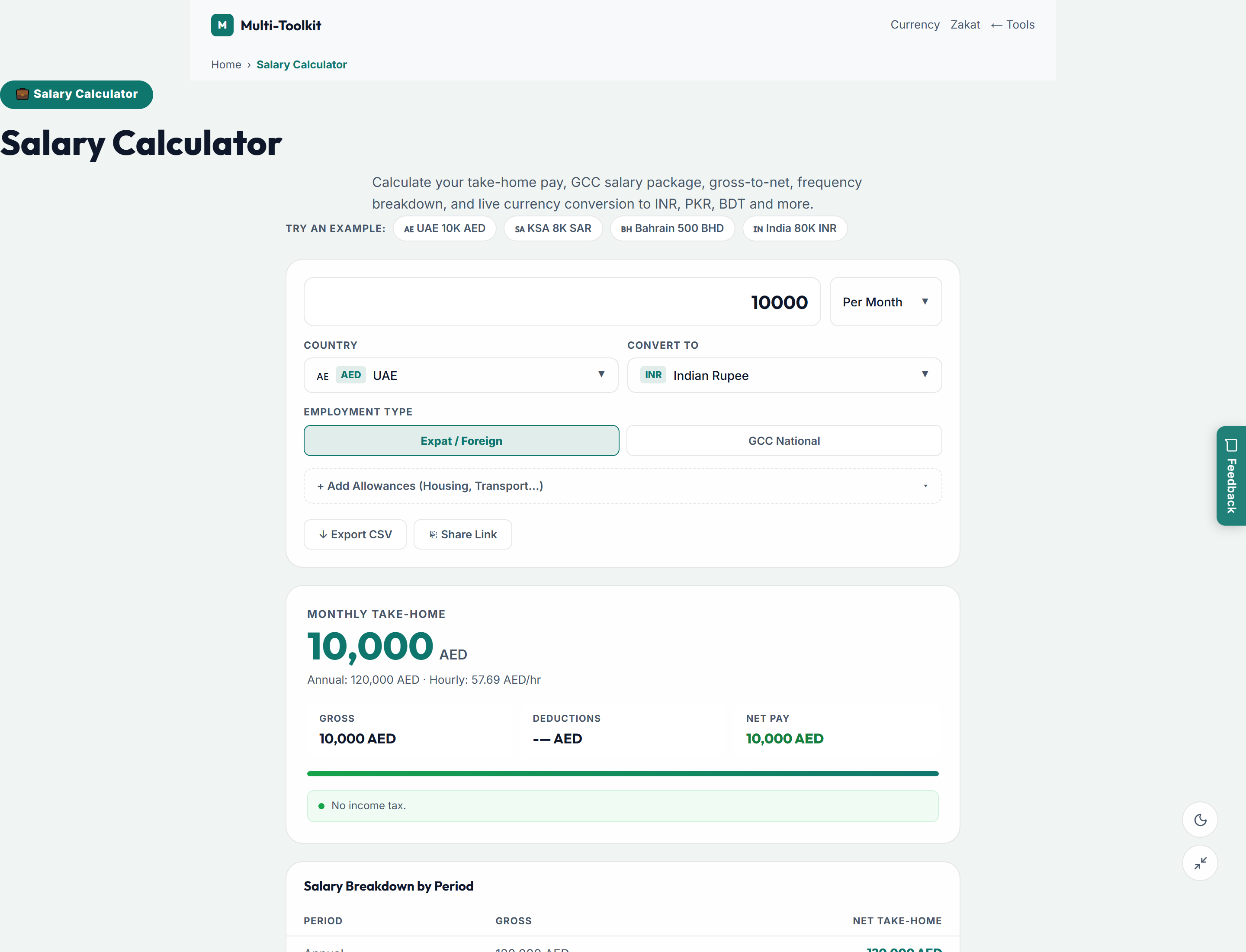
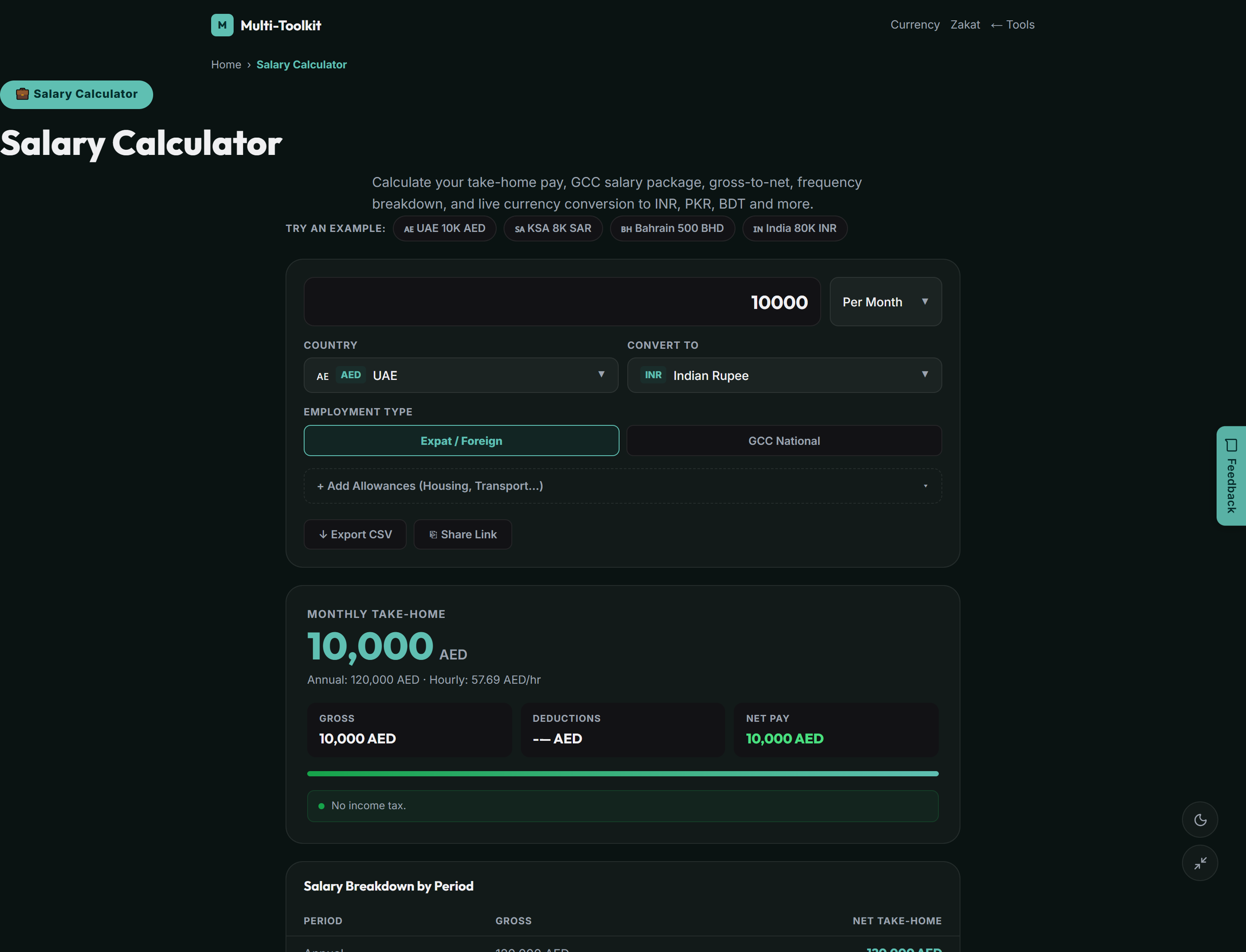
User interface: Light & dark modes
Designed with a clean, responsive interface that adapts seamlessly to desktop and mobile:
How to calculate your GCC take-home & gratuity base
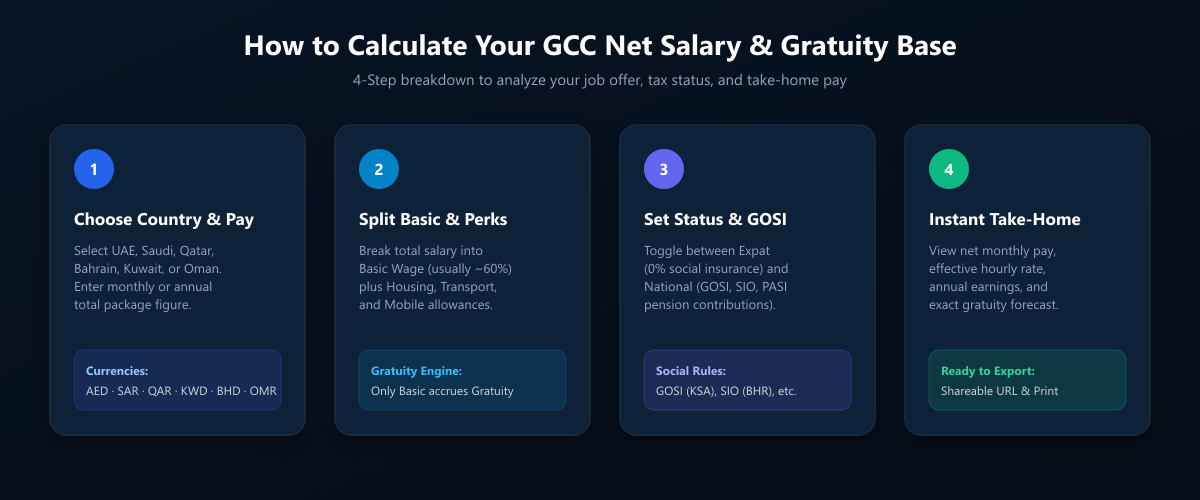
- Select your country & enter gross pay: Open the Salary Calculator, select your target GCC country (e.g., UAE or Saudi Arabia), and enter your monthly or annual salary offer.
- Structure your basic salary and allowances: Enter your exact basic wage and designated allowances (Housing, Transport, Mobile). If your contract specifies only a total lump sum, the tool helps you model the standard 60% Basic / 40% Allowances regional benchmark.
- Set your nationality status (GOSI / Social Insurance): Indicate whether you are an expatriate (0% statutory deduction) or a GCC national (subject to statutory pension deductions like GOSI in KSA or SIO in Bahrain).
- Review your true take-home & gratuity forecast: Review your net monthly income, your effective hourly rate, and your qualifying base for end-of-service gratuity accrual.
Why you should always negotiate a higher basic salary
In the GCC, negotiating your package structure is just as critical as negotiating the total number:
| Benefit / Entitlement | How It Is Calculated in the GCC | Impact of Higher Basic |
|---|---|---|
| End-of-Service Gratuity | Strictly based on Last Basic Salary in UAE, Qatar, Bahrain, Kuwait & Oman | Direct Increase: A 20% higher basic yields a 20% larger severance payout. |
| Overtime Pay | Statutory overtime multipliers under labor law are pegged to Basic Wage | Higher hourly overtime payout. |
| Annual Leave Encashment | Unused vacation cashout is calculated on Basic Salary | Higher cash value for untaken leave days. |
| Bank Loans & Mortgages | UAE and Saudi banks weight Basic Salary when assessing debt-burden ratios | Higher maximum loan and mortgage qualification. |
| Monthly Cashflow | Total monthly gross (Basic + Allowances) paid directly to your bank | Identical monthly deposit into your bank account. |
Negotiation Rule of Thumb: If an employer offers a total package of AED 25,000, aim for at least AED 15,000 basic (60%) and resist attempts to depress basic salary below 50% (e.g., AED 8,000 basic with AED 17,000 allowances).
Multi-Toolkit vs. generic salary calculators
| Feature | Multi-Toolkit Salary Calculator | Western Income Tax Calculators | Generic HR Blog Tables |
|---|---|---|---|
| GCC 0% Income Tax Handling | Accurate 0% tax default | Deducts 20–35% phantom tax | Static text only |
| Basic vs Allowance Breakdown | Interactive 4-part split | Single consolidated input | Manual calculation |
| Social Insurance (GOSI/SIO) | Citizen vs Expat rules | Treats all as taxed citizens | Ignored |
| Gratuity Linkage | Directly shows gratuity base | None | None |
| All 6 GCC Currencies | AED, SAR, QAR, KWD, BHD, OMR | USD / EUR / GBP only | Single currency |
| Privacy & Zero Data Storage | 100% In-Browser | Captures email & cookies | Ad-heavy |
Frequently asked questions
Is there personal income tax on salaries in the UAE, Saudi Arabia, or Qatar?
No. There is 0% personal income tax on employment earnings for individuals working in the UAE, Saudi Arabia, Qatar, Bahrain, Kuwait, and Oman. Expatriates take home 100% of their gross agreed compensation (minus any employer-specific voluntary deductions like supplementary pensions or company visa deposits).
What is the standard ratio between Basic Salary and Allowances in the GCC?
In standard multinational and established regional contracts, Basic Salary typically constitutes 60% of total monthly compensation, with the remaining 40% split between Housing Allowance (~25% to 30%) and Transportation (~10% to 15%). While some companies offer a 50/50 split, anything below 50% basic is considered sub-optimal for the employee.
Do allowances count toward end-of-service gratuity?
In the UAE (Federal Decree-Law 33/2021), Qatar (Law 14/2004), Bahrain (Law 36/2012), Kuwait (Law 6/2010), and Oman (RD 53/2023), statutory gratuity is calculated strictly on your Last Basic Salary, excluding all allowances. In Saudi Arabia (Article 84), gratuity is calculated on the “Actual Wage”, which includes basic salary plus fixed regular allowances.
What is GOSI and who pays it?
GOSI (General Organization for Social Insurance) is Saudi Arabia’s state social insurance and pension scheme. Under Saudi labor regulations, Saudi national employees contribute 9.75% of their basic wage plus housing allowance toward retirement and unemployment insurance, while employers contribute an additional matching portion. Non-Saudi expatriates do not pay retirement GOSI.
How do I calculate my effective hourly rate from a monthly salary?
To determine your effective hourly rate, multiply your monthly salary by 12 to find your annual compensation, then divide by the total annual working hours (standard 40-hour week = 2,080 hours/year; 48-hour week = 2,496 hours/year). The Salary Calculator computes this automatically.
Can my employer unilaterally reduce my basic salary to lower gratuity liabilities?
No. Under UAE, Saudi, and GCC labor laws, an employer cannot unilaterally reduce an employee’s basic salary or alter contract terms without the employee’s explicit written consent and approval from the relevant Ministry of Human Resources (MOHRE in UAE, MHRSD in KSA).
Calculate your exact GCC take-home pay and package breakdown — 100% free and private:
Open Salary Calculator →Related GCC career & finance tools: End of Service Calculator · AI Resume Builder · Currency Converter · Leave Calculator · Zakat Calculator