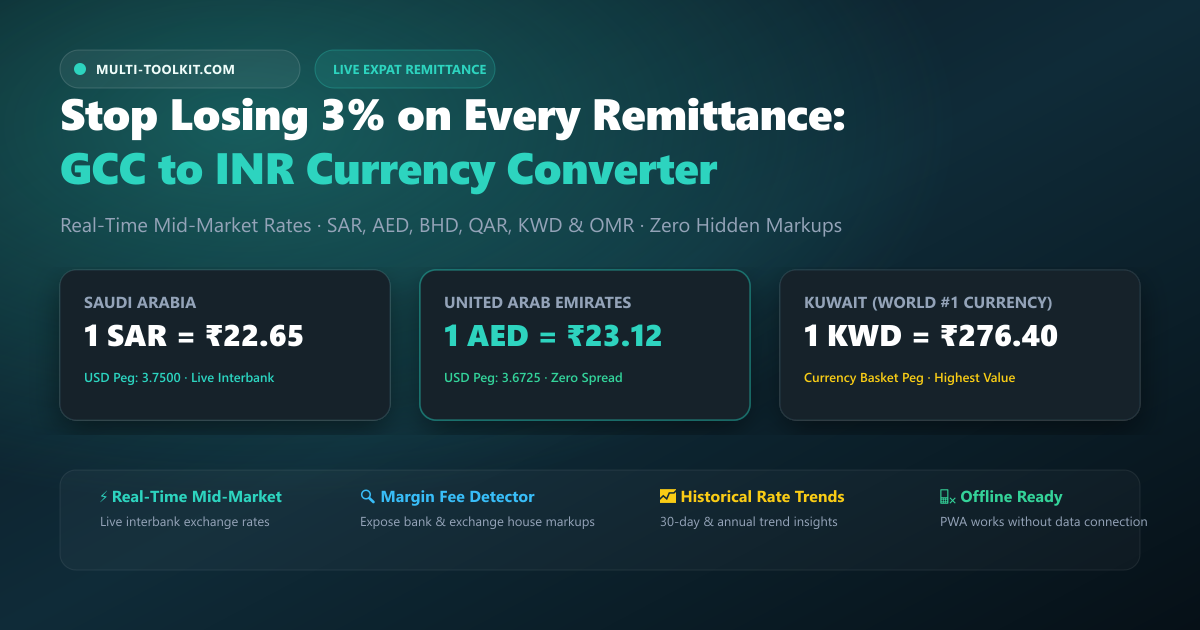
Stop losing 3% on every expat remittance: check the live, uninflated mid-market exchange rate across SAR, AED, BHD, QAR, KWD, and OMR before transferring money home.
Every month, millions of expatriates in the United Arab Emirates, Saudi Arabia, Qatar, Bahrain, Kuwait, and Oman transfer a portion of their hard-earned salary back home to India, Pakistan, Bangladesh, and the Philippines.
When walking into a commercial exchange house or opening a banking app, you are often greeted with bold promotional banners boasting “Zero Transfer Fees!” or “Flat 10 AED Remittance.” What most expats do not realize is that the transfer fee is a decoy: banks and exchange counters make the vast majority of their profit by marking down the exchange rate by 1.5% to 4% below the real interbank rate.
On a transfer of 5,000 AED or 5,000 SAR, an invisible 2.5% rate markdown silently strips ₹2,800 to ₹3,000 INR out of your family’s pocket on every single transaction. Over a standard 3-year employment contract, that adds up to over ₹100,000 INR lost to hidden margins.
Multi-Toolkit solves this transparency gap with its GCC to INR Currency Converter—a 100% free, real-time gcc to inr currency converter live tool that tracks live mid-market rates, exposes hidden bank margins, and accurately models USD-pegged Gulf currencies with zero spread.
The 3 hidden traps of Gulf remittance services
1. The “Zero-Fee” exchange rate markdown
When an exchange house advertises “0% commission”, they simply widen the exchange rate spread. If the true mid-market rate is ₹23.12 per 1 AED, the counter may offer you ₹22.55 per 1 AED. You pay no upfront “fee”, but you receive ₹2,850 less on a 5,000 AED transfer.
2. Failure to account for official USD pegs
Five of the six GCC currencies—the Saudi Riyal (SAR = 3.75), UAE Dirham (AED = 3.6725), Bahraini Dinar (BHD = 0.376), Qatari Riyal (QAR = 3.64), and Omani Rial (OMR = 0.3845)—are legally pegged to the US Dollar by their respective central banks. Many generic online currency converters treat these as floating currencies and display inaccurate, delayed cross-rates.
3. Stale rates and asymmetric weekend spreads
Retail banks and airport kiosks freeze their exchange rates over weekends or during market volatility, setting an artificially low rate to protect their profit margins against currency swings while charging you the penalty.
The solution: transparent mid-market interbank feeds
The Multi-Toolkit Currency Converter eliminates the guesswork by calculating conversions against the real mid-market interbank exchange rate—the exact midpoint between global buy and sell prices used by central banks and institutional forex traders.
Why this currency converter wins:
- ⚡ Real-Time Mid-Market Feed: Shows the exact, unbiased interbank exchange rate with zero spread inflation.
- 🏛️ 100% GCC Currency Coverage: Full support for Saudi Riyal (SAR), UAE Dirham (AED), Bahraini Dinar (BHD), Qatari Riyal (QAR), Kuwaiti Dinar (KWD), and Omani Rial (OMR).
- 🔍 Margin Transparency: Use the benchmark to instantly spot how much your exchange house or bank is skimming off the top.
- 🔄 Instant Bidirectional Conversion: Type in the sending or receiving box with instant keystroke calculations.
- 📴 Offline Ready (PWA): Works seamlessly offline using locally cached daily central bank reference rates.
Designed for high-speed expat workflows
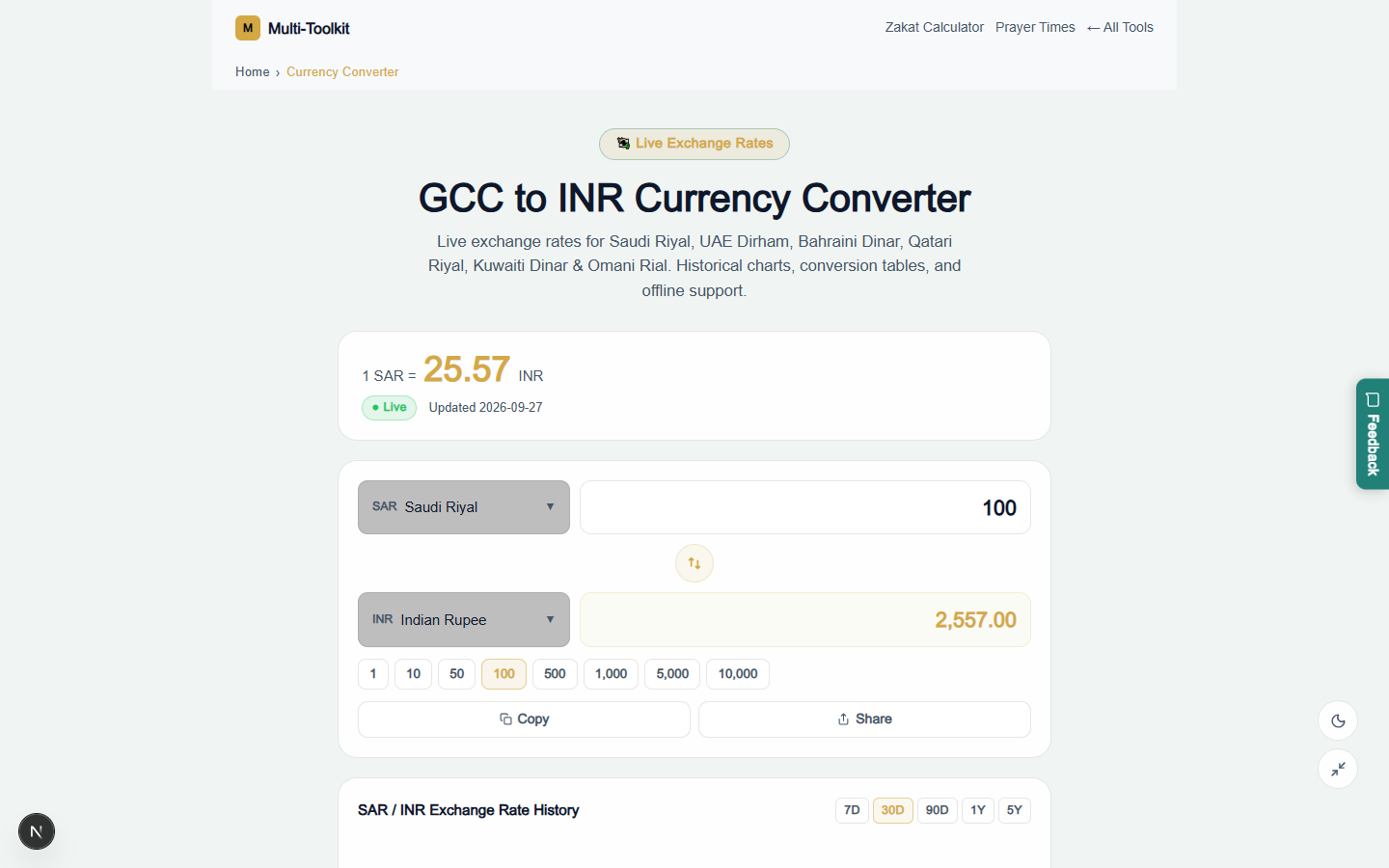
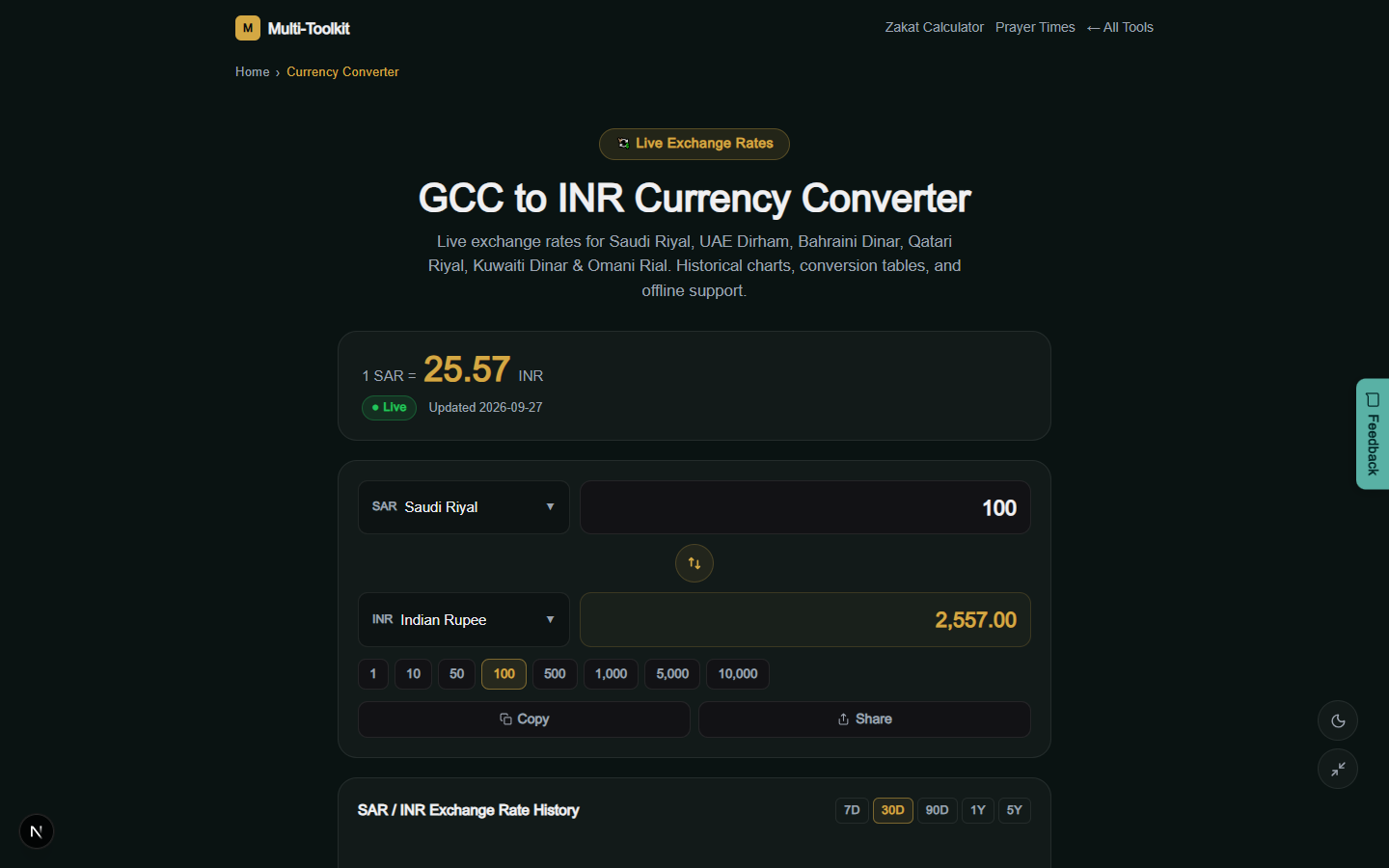
Multi-Toolkit provides a clean, responsive interface optimized for mobile phones and desktops, complete with both Nordic Light and Midnight Dark modes.
Light mode view
Dark mode view
How to check your true remittance in 4 steps
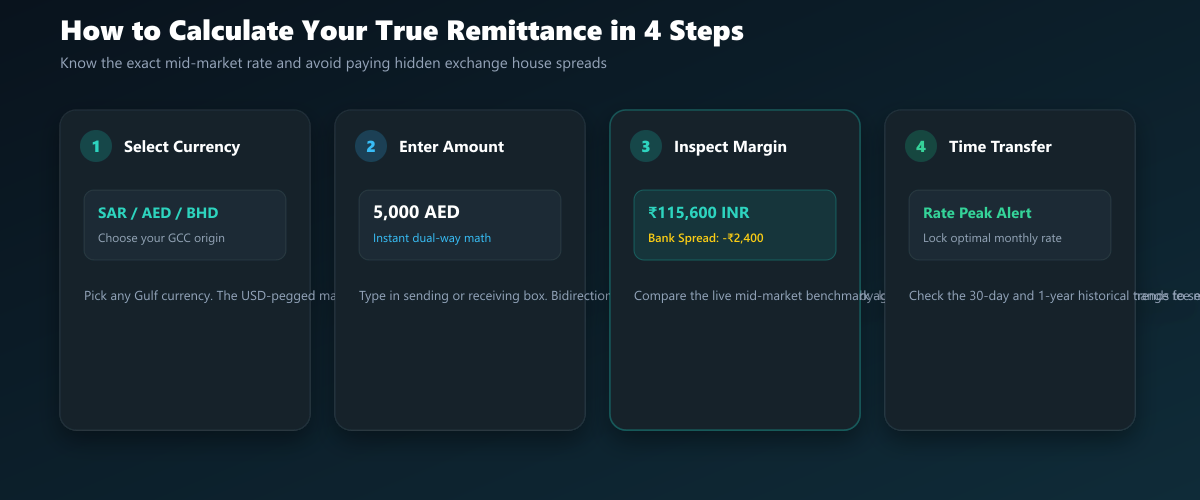
- Select Your Currency: Open the Currency Converter and pick your GCC currency (SAR, AED, BHD, QAR, KWD, or OMR).
- Enter the Amount: Type the amount you want to transfer (or enter your target INR/PKR amount to see what you need to send).
- Inspect the Mid-Market Rate: Review the live baseline exchange rate and historical 30-day movement.
- Benchmark Your Remittance Provider: Compare this true rate against the quote from your bank or money exchange app to ensure you aren’t paying more than 0.5% in total spread.
Who this tool is for
- GCC Expatriates: Indian, Pakistani, Bangladeshi, and Filipino professionals sending monthly remittances home from Dubai, Riyadh, Manama, Doha, Kuwait City, or Muscat.
- Business Owners & Procurement: SME founders in the Gulf paying international suppliers and offshore development teams.
- Freelancers & Contractors: Remote workers pricing international retainers in Dirhams, Riyals, or Dollars.
- Travelers & Relocating Expats: Individuals planning trips, calculating cost-of-living adjustments, or converting savings.
Comparison: Multi-Toolkit vs. Exchange Houses vs. Retail Banks
| Feature | Multi-Toolkit Currency Converter | Commercial Exchange Houses | Retail Bank Wire Transfers |
|---|---|---|---|
| Exchange Rate Spread | 0% (Pure Mid-Market Rate) | Moderate (1.2% – 2.8% margin) | High (2.5% – 4.5% margin) |
| Hidden Margin Exposure | Exposes true interbank rate | Buried in fine print | Obscured in “no fee” claims |
| GCC USD Peg Accuracy | Instant central bank peg parity | Varies by branch | Delayed bank fixing |
| Speed & Friction | Instant browser calculation | Ads, app installs, queue lines | Slow login & SMS OTPs |
| Works Offline | Yes (Full PWA caching) | No | No |
| Cost | 100% Free Forever | Transaction fees + spread | Account required |
Frequently asked questions
What is the current SAR and AED exchange rate to Indian Rupee (INR)?
The Saudi Riyal (SAR) typically trades around ₹22.40 to ₹22.80 INR, and the UAE Dirham (AED) trades around ₹22.80 to ₹23.30 INR. Because both currencies are strictly pegged to the US Dollar (USD), their exact exchange rate against INR fluctuates in direct correlation with the USD/INR currency pair.
Why are GCC exchange rates pegged to the US Dollar?
To ensure macroeconomic stability and protect oil and energy export revenues, Saudi Arabia, UAE, Qatar, Bahrain, and Oman maintain a fixed currency peg to the USD. Kuwait pegs the Kuwaiti Dinar (KWD) to an undisclosed weighted currency basket heavily weighted toward the USD.
Which GCC currency has the highest exchange rate in the world?
The Kuwaiti Dinar (KWD) is the most valuable currency unit in the world, followed by the Bahraini Dinar (BHD) and the Omani Rial (OMR). A single Kuwaiti Dinar converts to over ₹270–₹280 INR or $3.25+ USD.
How do money transfer apps and exchange counters hide their fees?
Instead of charging a visible upfront fee, many providers offer an exchange rate 1.5% to 4% below the live interbank market rate. They buy currency at the wholesale mid-market rate and sell it to you at a marked-down retail rate, pocketing the spread as hidden profit.
When is the best time of the month to send money to India or Pakistan?
Exchange rates fluctuate based on global macroeconomic indicators, US Federal Reserve announcements, and trade balances. Tracking the historical 30-day chart on Multi-Toolkit lets you identify rate peaks and time your monthly remittance for maximum return.
Does this currency converter work offline?
Yes. Multi-Toolkit is built as a Progressive Web App (PWA). Once loaded, the converter caches the latest exchange rate table in your browser, allowing you to perform accurate conversions even without an active data connection.
Check live mid-market GCC exchange rates and benchmark your remittance — 100% free:
Open GCC Currency Converter →Related GCC Finance & Expat Tools: Salary Calculator · End of Service Gratuity · GCC VAT Calculator · Zakat Calculator · Working Days Calculator