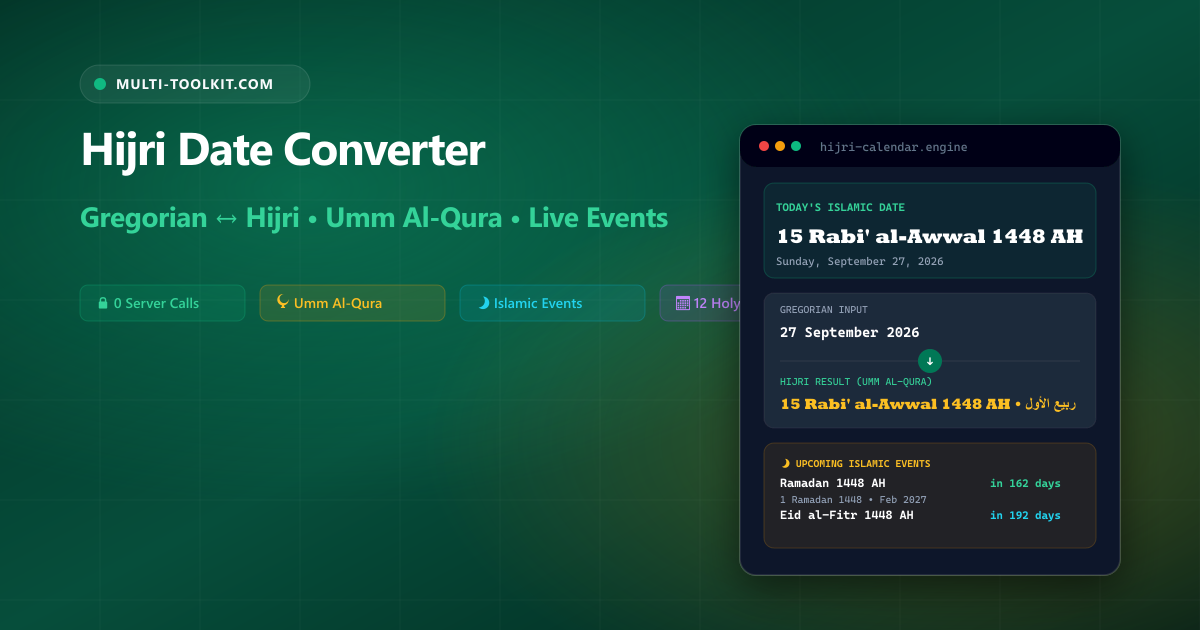
Bridge the lunar and solar calendars with astronomical precision: convert dates bi-directionally between Gregorian and Hijri, synchronize with the official Umm Al-Qura standard, and track upcoming Islamic events 100% in your browser.
The Islamic (Hijri) calendar is an astronomical lunar calendar used by over 1.9 billion Muslims worldwide to determine the sacred dates of Ramadan, Eid al-Fitr, the annual Hajj pilgrimage, and Eid al-Adha. Across the Gulf Cooperation Council (GCC)—especially in Saudi Arabia, the UAE, Qatar, Bahrain, Kuwait, and Oman—the Hijri calendar is also deeply integrated into civil records, residency permits (Iqama), commercial leases, and judicial timelines.
However, converting dates between the solar Gregorian and lunar Hijri calendars online is often hampered by common issues:
- The 1-Day Crescent Sighting Discrepancy: Month declarations in the Islamic calendar traditionally rely on the physical or calculated visibility of the new crescent moon (Hilal). Basic web converters fail to specify whether they use the civil Tabular arithmetic algorithm or the official Saudi Umm Al-Qura astronomical standard.
- One-Way Conversion Limitations: Many legacy tools only convert Gregorian dates to Hijri, failing to support reverse conversions from Hijri back to Gregorian for historical records or religious anniversary planning.
- Ad-Heavy Portals and Privacy Risks: Entering sensitive personal dates (such as birth dates, contract terms, or family occasions) into ad-riddled religious portals exposes personal queries to third-party ad brokers.
The Multi-Toolkit Hijri Converter provides an instant, dual-engine, and completely confidential calendar conversion studio running 100% locally in client-side memory.
The astronomical foundations of the Hijri calendar
Unlike the solar Gregorian calendar (which tracks the Earth’s revolution around the Sun in ~365.2425 days), the Hijri calendar is strictly lunar. It consists of 12 synodic months (lunations) that alternate between 29 and 30 days based on the lunar phase cycle:
- Standard Lunar Year: 354 days (approx. 10 to 12 days shorter than the solar year).
- Leap Lunar Year: 355 days (an extra day is added to the 12th month, Dhul-Hijjah, in 11 out of every 30 years).
- Seasonal Shift: Because the lunar year is ~11 days shorter than the solar year, Islamic months and holidays drift backward through the Gregorian seasons every ~33 solar years.
- Historical Epoch: Year 1 AH (Anno Hegirae) began on 16 July 622 CE, commemorating the migration (Hijra) of Prophet Muhammad ﷺ from Mecca to Medina.
Dual interface & comprehensive Islamic date studio
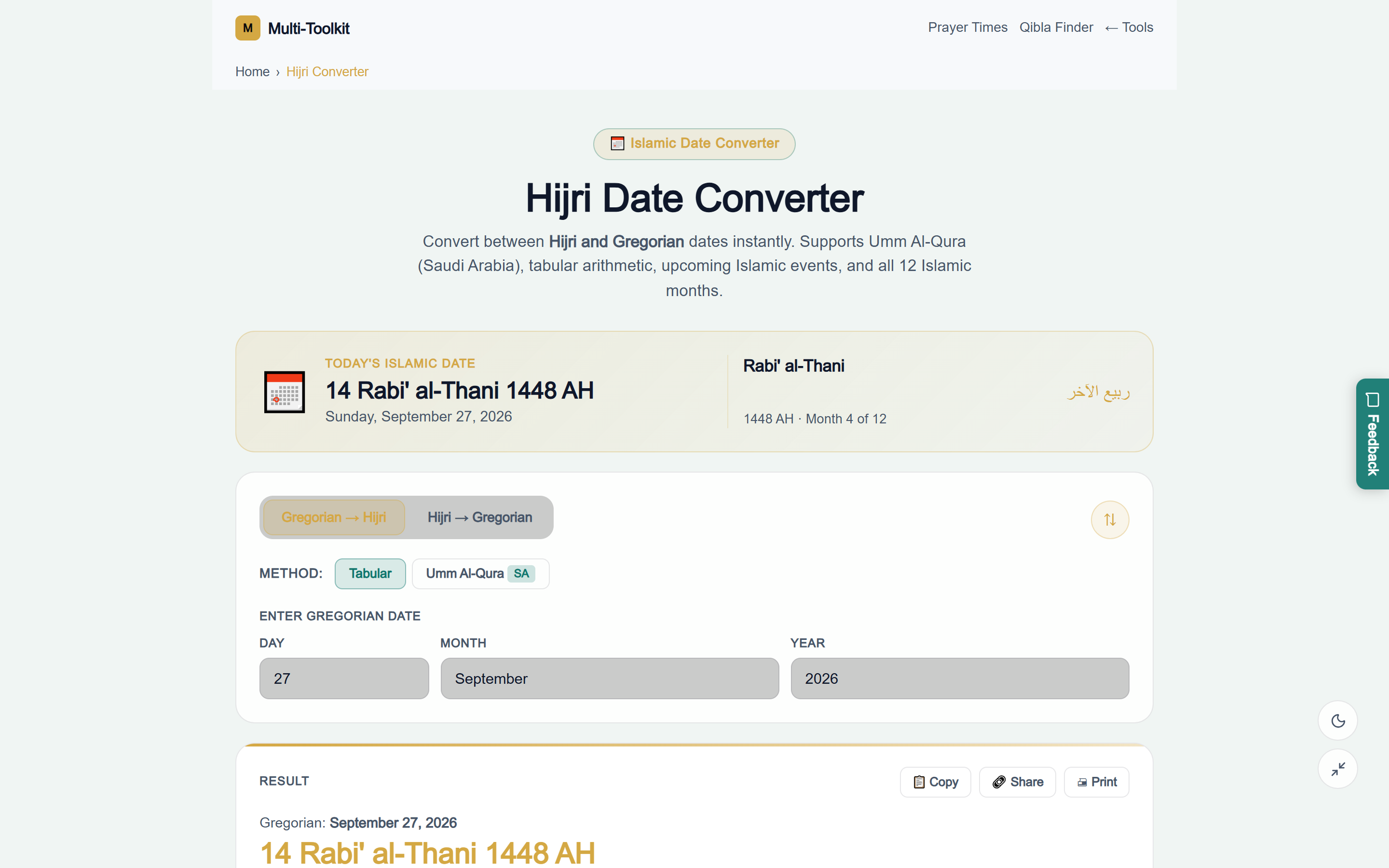
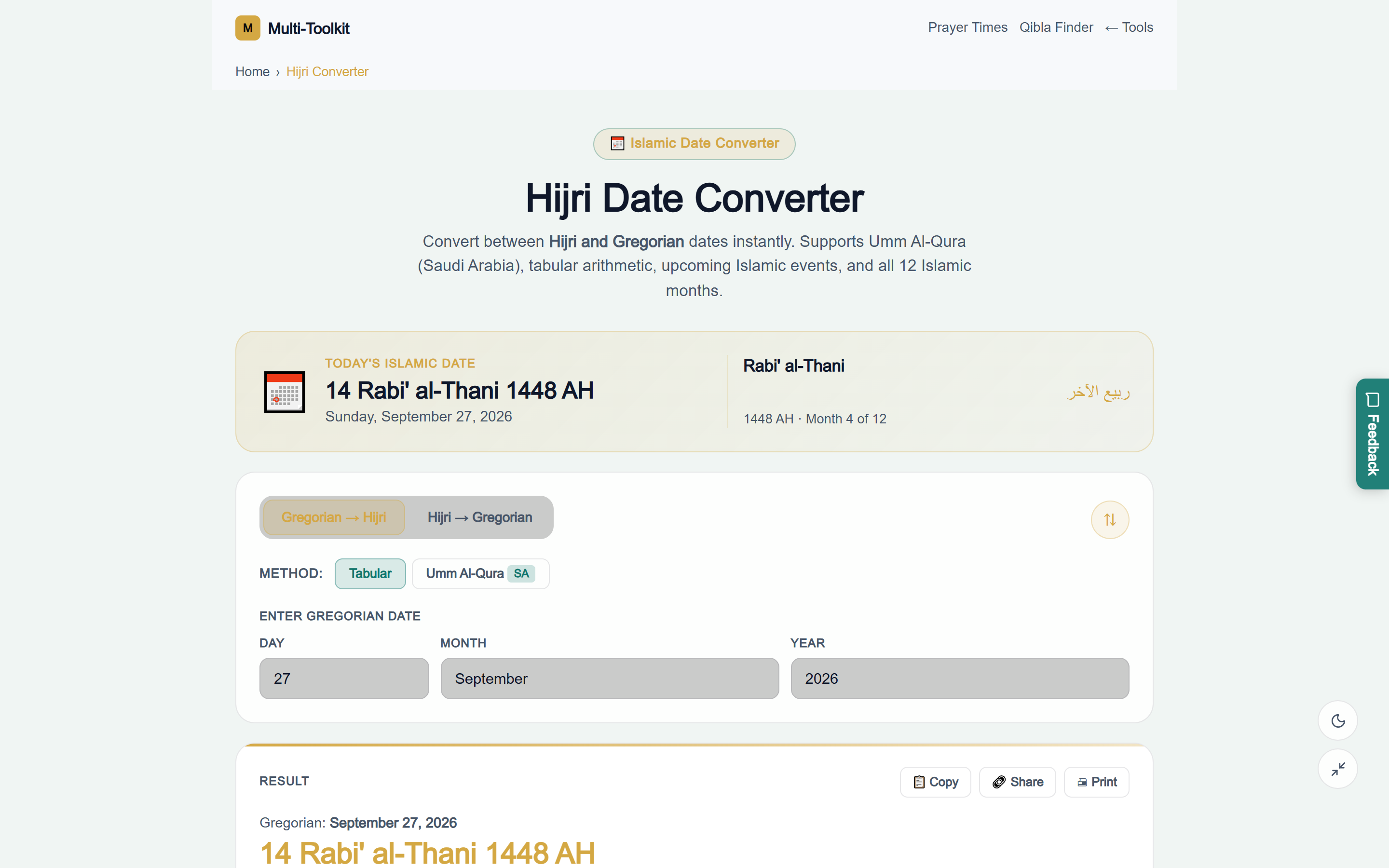
Explore the clean dual-theme interface featuring bi-directional conversion, today’s date card, event countdowns, and 12-month guide:
The 12 Islamic months: structure & spiritual significance
The Hijri calendar is structured into 12 lunar months, four of which are designated in the Quran as Al-Ashhur Al-Hurum (The Sacred Months, wherein warfare was historically prohibited):
| # | Month (English) | Arabic Script | Days | Religious & Cultural Significance |
|---|---|---|---|---|
| 1 | Muharram | محرم | 30 | Sacred Month. Islamic New Year (1st) & Day of Ashura (10th). |
| 2 | Safar | صفر | 29 | Second month; historically a seasonal month of travel and trade. |
| 3 | Rabi’ al-Awwal | ربيع الأول | 30 | Commemorates the birth of Prophet Muhammad ﷺ (Mawlid al-Nabi, 12th). |
| 4 | Rabi’ al-Thani | ربيع الآخر | 29 | Second spring month; a period of regular spiritual reflection. |
| 5 | Jumada al-Awwal | جمادى الأولى | 30 | First of the two mid-year seasonal lunar months. |
| 6 | Jumada al-Thani | جمادى الآخرة | 29 | Marks the exact halfway midpoint of the Islamic lunar calendar. |
| 7 | Rajab | رجب | 30 | Sacred Month. Commemorates the miraculous Isra wal-Miraj (27th). |
| 8 | Sha’ban | شعبان | 29 | Month of spiritual preparation and increased voluntary fasting before Ramadan. |
| 9 | Ramadan | رمضان | 30 | The Holiest Month. Daily fasting from dawn to sunset & Laylat al-Qadr. |
| 10 | Shawwal | شوال | 29 | Begins with Eid al-Fitr (1st); includes the recommended 6 days of fasting. |
| 11 | Dhul-Qa’dah | ذو القعدة | 30 | Sacred Month. Peace is mandated; international Hajj pilgrimage journeys commence. |
| 12 | Dhul-Hijjah | ذو الحجة | 29 / 30 | Sacred Month. Annual Hajj pilgrimage, Day of Arafah (9th) & Eid al-Adha (10th). |
Julian Day Number (JDN) mathematical algorithm
To execute seamless bi-directional conversion without cumulative rounding errors, the Multi-Toolkit converter uses the astronomical Julian Day Number (JDN) as an intermediate continuous epoch counter:
// Gregorian date -> JDN -> Hijri date
function gregorianToHijri(year, month, day) {
  // 1. Convert Gregorian to JDN
  const a = Math.floor((14 - month) / 12);
  const y = year + 4800 - a;
  const m = month + 12 * a - 3;
  const jdn = day + Math.floor((153 * m + 2) / 5) + 365 * y +
              Math.floor(y / 4) - Math.floor(y / 100) + Math.floor(y / 400) - 32045;

  // 2. Map JDN against Islamic epoch (16 July 622 CE = JDN 1948440)
  const l = jdn - 1948440 + 10632;
  const n = Math.floor((l - 1) / 10631);
  const l2 = l - 10631 * n + 354;
  const j = Math.floor((10985 - l2) / 5316) * Math.floor((50 * l2) / 17719) +
            Math.floor(l2 / 5670) * Math.floor((43 * l2) / 15238);
  const l3 = l2 - Math.floor((30 - j) / 15) * Math.floor((17719 * j) / 50) -
             Math.floor(j / 16) * Math.floor((15238 * j) / 43) + 29;

  const hijriMonth = Math.floor((24 * l3) / 709);
  const hijriDay = l3 - Math.floor((709 * hijriMonth) / 24);
  const hijriYear = 30 * n + j - 30;

  return { day: hijriDay, month: hijriMonth, year: hijriYear };
}
Upcoming Islamic events & holy holiday countdowns
The converter tracks real-time countdowns to major annual Islamic religious occasions:
- Ramadan: The 9th month of fasting, self-discipline, and Quranic recitation.
- Eid al-Fitr (1 Shawwal): The joyful celebration concluding the month of Ramadan.
- Day of Arafah (9 Dhul-Hijjah): The pinnacle of the annual Hajj pilgrimage.
- Eid al-Adha (10 Dhul-Hijjah): The Feast of Sacrifice commemorating the devotion of Prophet Ibrahim (Abraham).
- Islamic New Year (1 Muharram): The beginning of the new Hijri calendar year.
- Ashura (10 Muharram): The sacred fast commemorating the deliverance of Prophet Musa (Moses).
How to convert Hijri & Gregorian dates (3 simple steps)
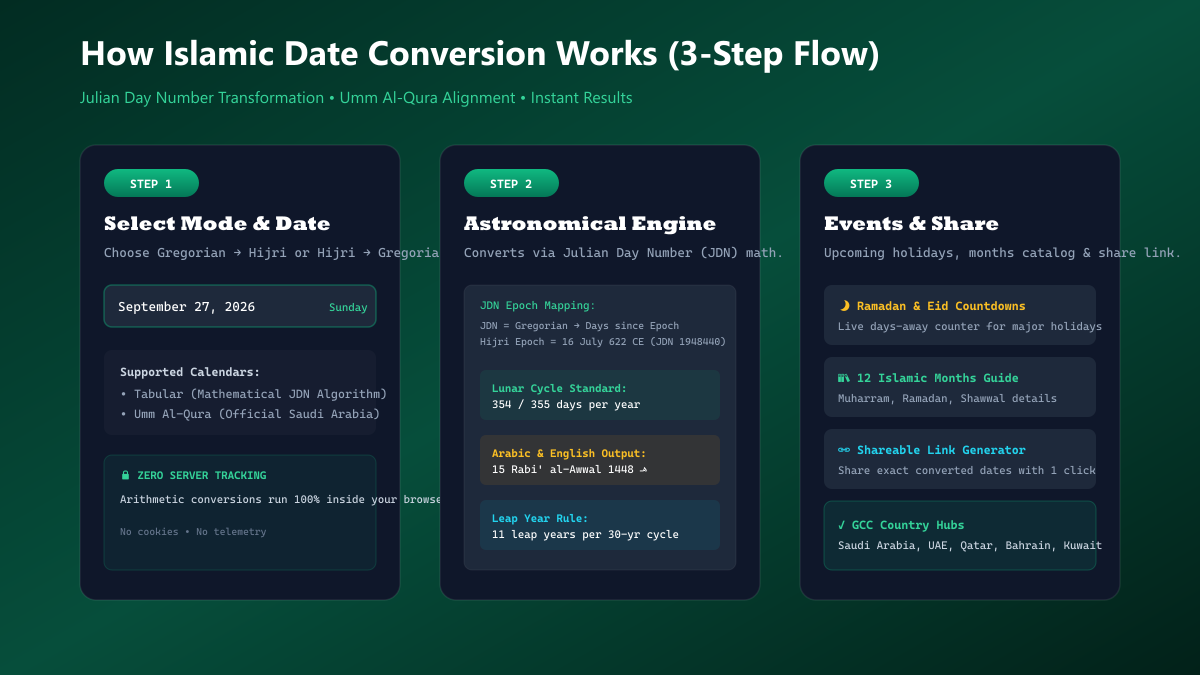
- Choose Conversion Direction: Click Gregorian → Hijri or Hijri → Gregorian depending on your source date.
- Enter the Date: Select the day, month, and year from the interactive dropdown menus.
- Copy or Share Your Result: View the converted result formatted in both English and Arabic. Click the copy icon or shareable URL button for instant distribution.
Comparison: Multi-Toolkit vs legacy Islamic date converters
| Feature | Multi-Toolkit | Basic Web Calculators | Ad-Supported Portals |
|---|---|---|---|
| Bi-Directional Conversion | Yes (Instant Toggle) | One-way only | Separate page reloads |
| Umm Al-Qura Alignment | Supported (Official Saudi) | No | Varies |
| Today’s Live Islamic Date | Arabic & English auto-sync | Static text | Cluttered with banner ads |
| Islamic Holiday Countdowns | Live dynamic timers | No | Static lists |
| 1-Click Shareable Permalinks | Yes | No | No |
| Privacy & Security | 100% In-Browser (0 Telemetry) | Server-side logging | Ad trackers & profiling cookies |
Frequently asked questions (FAQ)
What is today’s Hijri date?
Today’s Islamic date is calculated dynamically at the top of the converter using standard tabular Julian Day Number mathematics and aligned with the official Umm Al-Qura calendar.
How accurate is the Islamic date conversion?
The Tabular algorithm is mathematically precise based on the 30-year astronomical cycle. Regional civil dates may occasionally vary by ±1 day depending on local crescent moon sightings (Hilal).
What is the Umm Al-Qura calendar?
Umm Al-Qura is the official civil Islamic calendar of Saudi Arabia, calculated astronomically based on the coordinates of Mecca for religious occasions, government schedules, and civil contracts.
How many days are in an Islamic year?
The Islamic lunar year consists of 12 synodic months totaling 354 days in standard years and 355 days in leap years (11 leap years per 30-year cycle).
Can I convert dates in both directions?
Yes. The Multi-Toolkit converter seamlessly converts both Gregorian dates to Hijri and Hijri dates to Gregorian.
Is my date data tracked or sent across the network?
No. All arithmetic conversions execute 100% locally in your web browser memory with zero server telemetry.
Explore related Islamic & date tools
- Qibla Finder — Real-time GPS and compass direction to the Holy Kaaba in Mecca.
- Age Calculator — Exact chronological age breakdown, birthday countdown, and life milestones.
- Working Days Calculator — Count business days excluding weekends and GCC public holidays.
- Annual Leave Calculator — Calculate statutory vacation days under GCC labor laws.
- Timestamp Converter — Convert Unix epoch timestamps to human-readable datetime formats.
Convert Gregorian and Islamic Hijri dates with precision and complete privacy:
Open Free Hijri Converter →