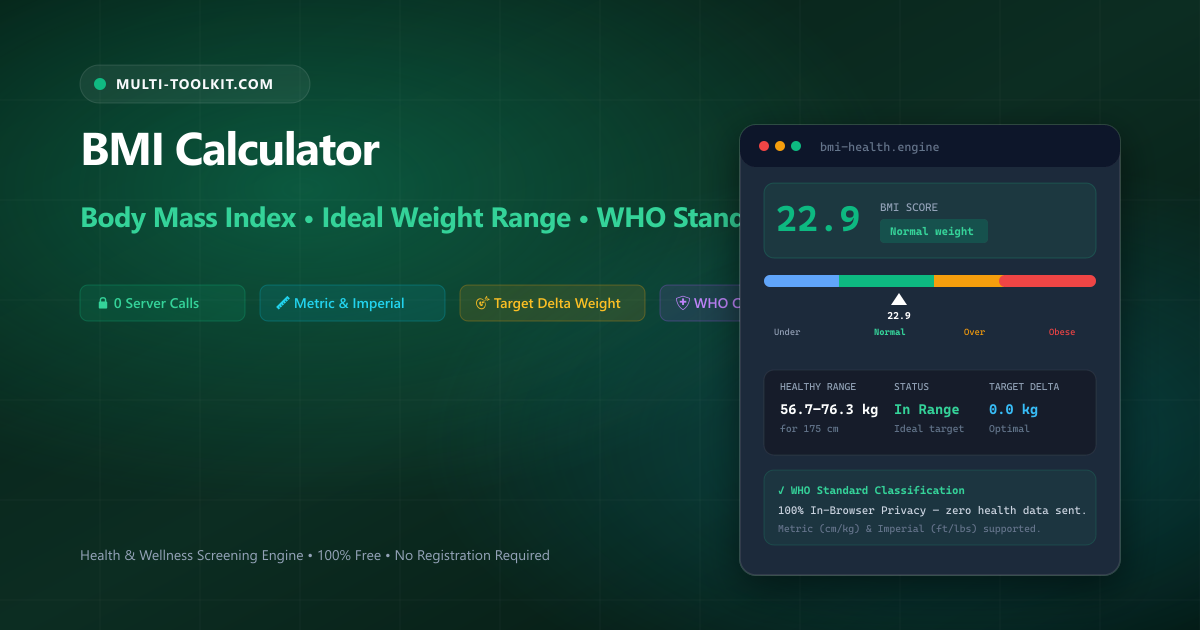
Screen your biometric health with clinical precision: calculate your Body Mass Index, explore height-specific ideal weight ranges, and discover your exact target weight delta 100% inside your browser.
Body Mass Index (BMI) is universally utilized by medical practitioners, fitness coaches, epidemiologists, and health educators as a non-invasive screening tool to assess whether an individual falls within an optimal body mass range for their height.
However, traditional web calculators frequently fall short of providing actionable clinical clarity:
- The Missing Context: Providing a raw number like “28.1” without calculating your exact height-specific healthy weight boundaries (the 18.5–24.9 BMI band) leaves users with ambiguous goals.
- The Missing Target Delta: Knowing your classification is incomplete without knowing the exact amount of weight (in kg or lbs) required to cross into the normal weight tier.
- Privacy in Health Tracking: Submitting personal height, weight, and biometric records to ad-supported wellness portals exposes private health queries to third-party advertising brokers.
The Multi-Toolkit BMI Calculator delivers fast, unbiased, and completely confidential biometric screening with zero tracking.
World Health Organization (WHO) adult BMI classifications
The WHO classifies adult nutritional status and weight-associated health risks into six standardized international tiers:
| BMI Range (kg/m²) | Classification | Clinical & Health Context |
|---|---|---|
| Below 18.5 | Underweight | Higher statistical risk of nutrient deficiency and low bone density. |
| 18.5 – 24.9 | Normal weight | Lowest statistical risk for cardiovascular and metabolic disorders. |
| 25.0 – 29.9 | Overweight | Modest elevated risk; lifestyle and dietary adjustments recommended. |
| 30.0 – 34.9 | Obese Class I | Moderate risk of hypertension, dyslipidemia, and type 2 diabetes. |
| 35.0 – 39.9 | Obese Class II | Severe risk; structured medical and nutritional guidance advised. |
| 40.0 & above | Obese Class III | Very high risk; comprehensive clinical intervention recommended. |
In-browser architecture: private biometric screening with zero latency
Multi-Toolkit executes all BMI math, healthy range boundaries, and target delta calculations locally in client-side JavaScript with zero server transmissions.
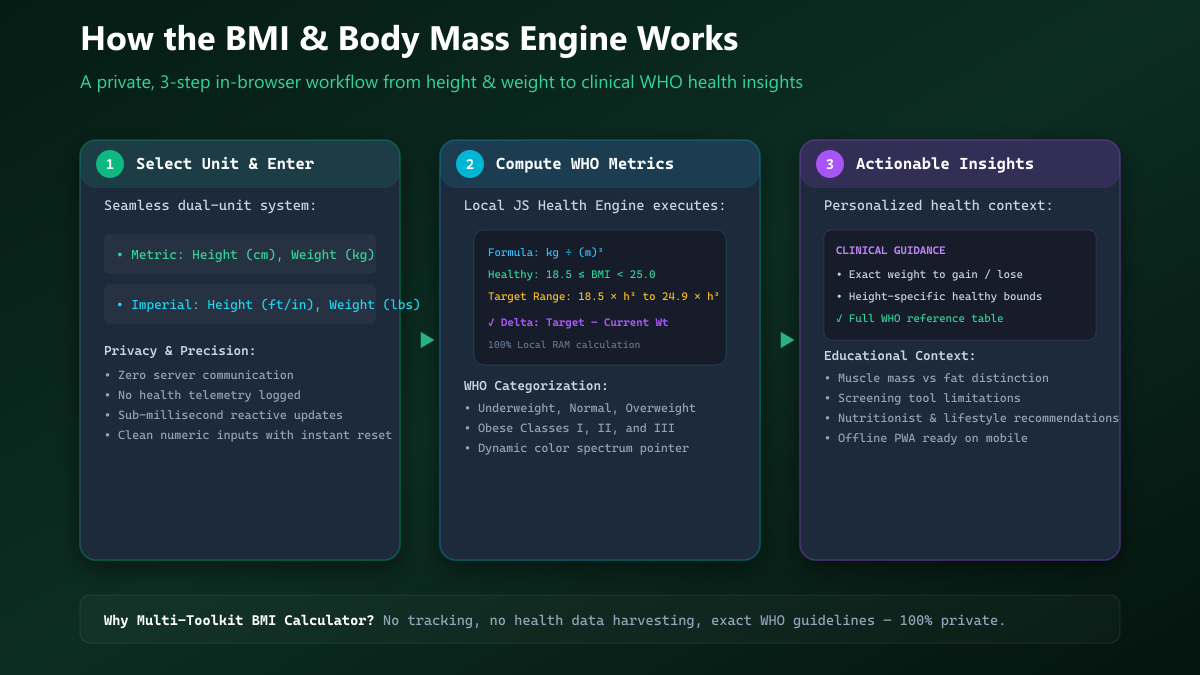
1. Select Unit & Enter
Choose Metric (cm/kg) or Imperial (ft/in/lbs) with seamless state synchronization.
2. Real-Time WHO Engine
Calculates exact BMI score, maps to WHO tiers, and positions the visual spectrum pointer.
3. Target Range & Delta
Computes height-specific healthy weight boundaries and exact kg/lbs to gain or lose.
Core features & capabilities
| Feature | Multi-Toolkit Health Studio | Basic Phone App | Ad-Heavy Wellness Sites |
|---|---|---|---|
| Unit Systems | Seamless Metric & Imperial Toggle | Single Unit System | Requires Page Reload |
| Visual Scale Spectrum | Dynamic Colored Pointer Spectrum | None | Static or Absent |
| Healthy Weight Range | Exact Min & Max for Height | None | Often Paid Upgrade |
| Target Weight Delta | Exact kg/lbs to Gain or Lose | None | None |
| Clinical Insights | Tailored WHO Guidance & Disclaimers | Generic | Ad Banner Distractions |
| Privacy & Telemetry | 100% In-Browser (0 Data Sent) | Local OS App | Third-Party Ad Trackers |
Step-by-step interactive guide
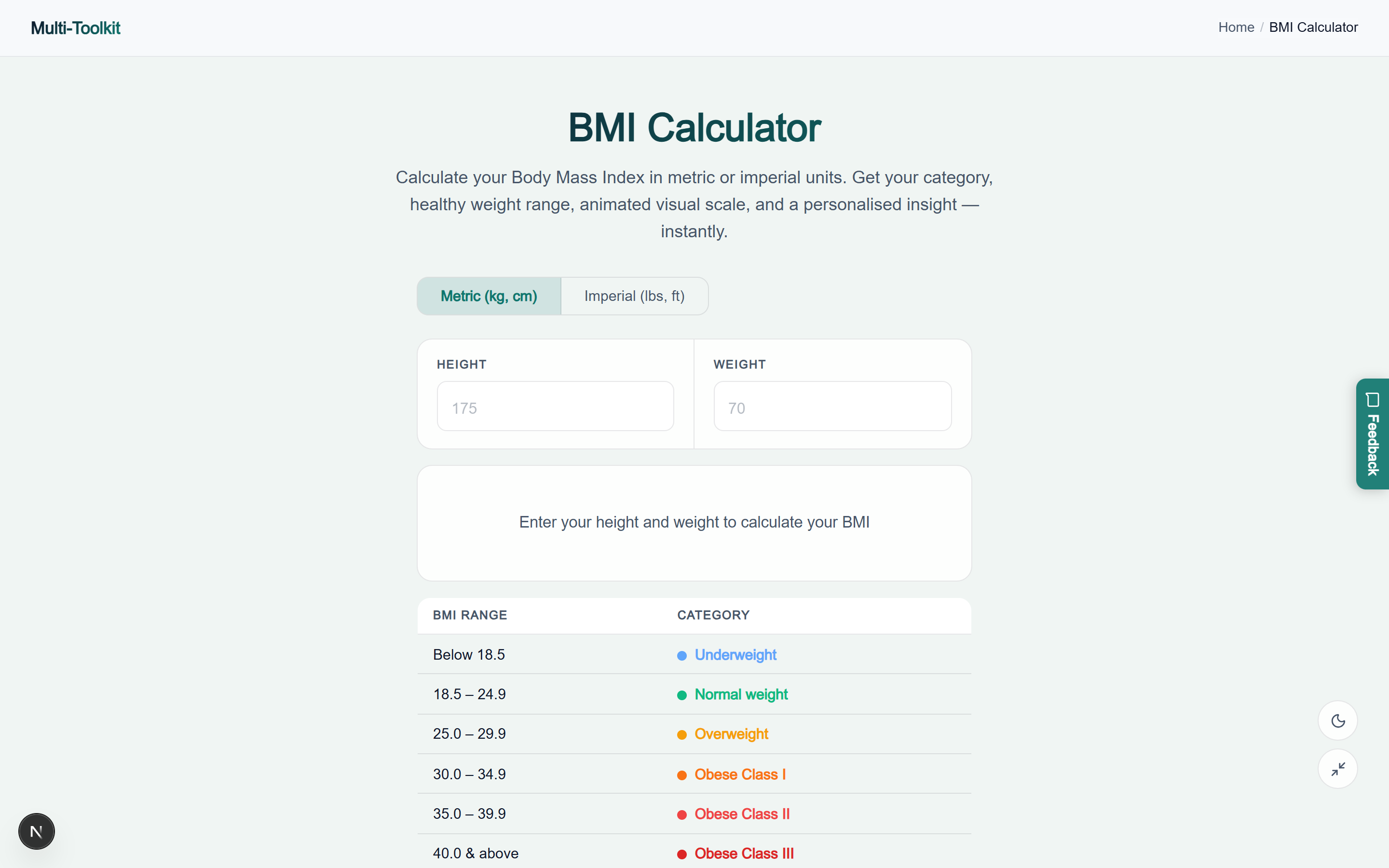
- Choose Unit System: Open the BMI Calculator. Click Metric (kg, cm) or Imperial (lbs, ft) depending on your preference.
- Enter Height & Weight: Type your height and body weight into the fields. The calculations update instantaneously without waiting for a page reload.
- Inspect Your BMI Score & Scale Position: Observe your exact BMI score, color-coded WHO category badge, and where your pointer lands on the visual spectrum scale.
- Review Ideal Weight & Target Delta: Check the Healthy Range box to see your height-specific target boundaries and the To Lose / To Gain box to identify your exact delta to reach the normal weight threshold.
Visual interface showcase: light & dark modes
Light Mode Interface
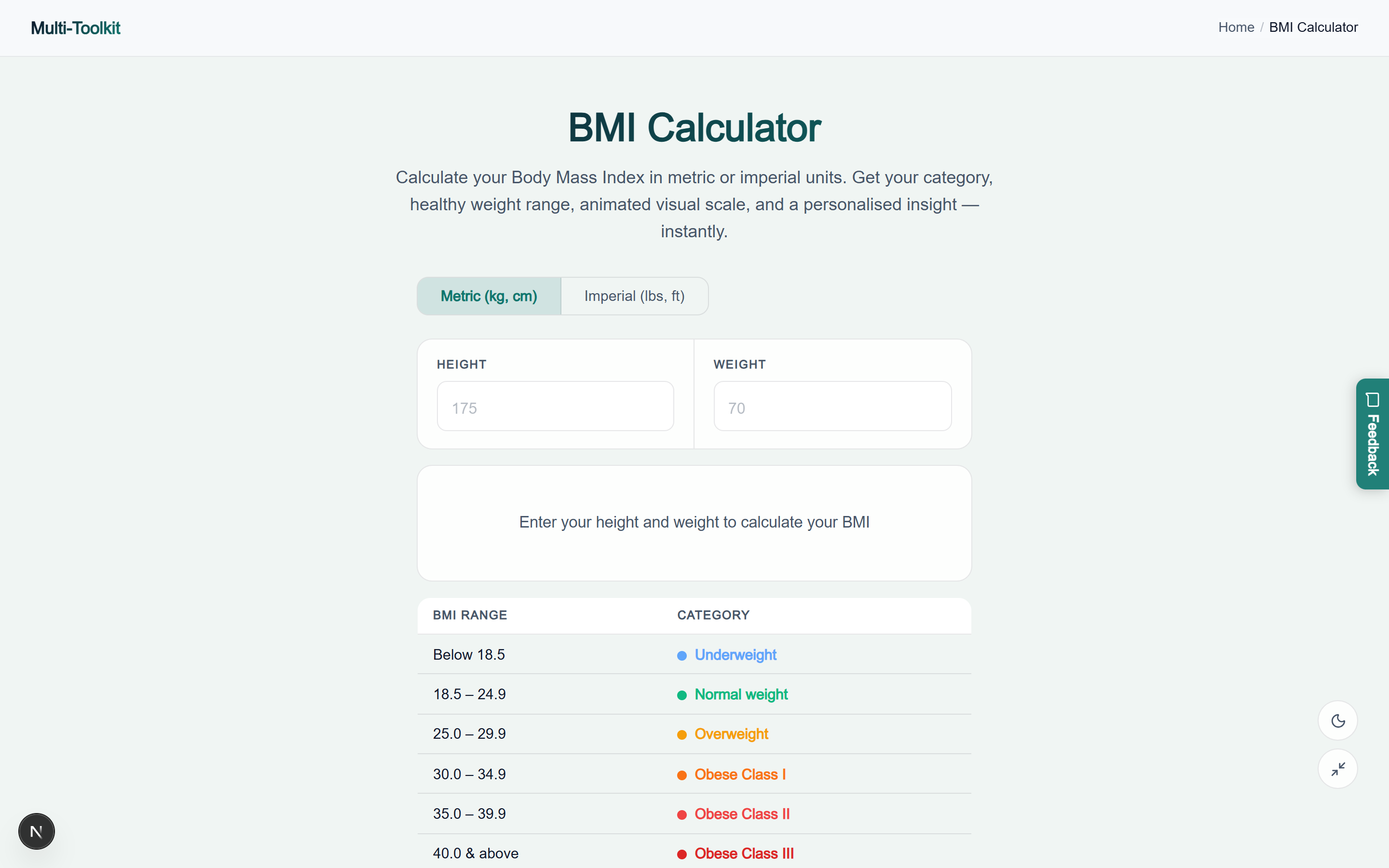
Dark Mode Interface
Technical deep dive: mathematical proofs & formulas
1. Metric BMI Formula
BMI = Weight (kg) / (Height (m))^2
Example: 70 kg, 175 cm (1.75 m)
BMI = 70 / (1.75 * 1.75) = 70 / 3.0625 = 22.86 (Normal weight)
2. Imperial BMI Formula
BMI = (Weight (lbs) * 703) / (Height (inches))^2
Example: 154 lbs, 5 ft 10 in (70 inches)
BMI = (154 * 703) / (70 * 70) = 108,262 / 4,900 = 22.09 (Normal weight)
3. Height-Specific Healthy Weight Range Formula
Min Healthy Weight (kg) = 18.5 * (Height in meters)^2
Max Healthy Weight (kg) = 24.9 * (Height in meters)^2
Example for 175 cm:
Min = 18.5 * 3.0625 = 56.7 kg (125.0 lbs)
Max = 24.9 * 3.0625 = 76.3 kg (168.2 lbs)
Five clinical nuances & limitations of BMI
1. Muscle density vs adipose tissue
Muscle tissue is approximately 18% denser than fat tissue. Muscular athletes and strength trainers frequently register elevated BMIs (27–31) while maintaining very low body fat percentages.
2. Fat distribution (visceral vs subcutaneous)
BMI does not evaluate where fat is stored. Visceral fat stored around internal organs in the abdomen carries significantly higher metabolic risk than subcutaneous fat around the lower body.
3. Age-related sarcopenia
Older adults naturally experience muscle and bone mass loss. A senior citizen may have a “normal” BMI while possessing insufficient muscle mass and elevated body fat.
4. Population and demographic variations
Clinical guidelines recognize that metabolic risk thresholds vary across ethnicities. For example, individuals of Asian descent often experience elevated cardiovascular risks at lower BMI thresholds (overweight starting at 23.0).
5. Screening tool vs diagnostic assessment
BMI serves as an initial screening benchmark, not a definitive health diagnosis. Comprehensive health evaluations should consider blood lipid profiles, blood pressure, fasting glucose, and body composition.
Height vs healthy weight reference matrix
| Height | Healthy Weight (kg) | Healthy Weight (lbs) |
|---|---|---|
| 150 cm (4'11") | 41.6 – 56.0 kg | 91.7 – 123.5 lbs |
| 160 cm (5'3") | 47.4 – 63.7 kg | 104.5 – 140.4 lbs |
| 170 cm (5'7") | 53.5 – 72.0 kg | 118.0 – 158.7 lbs |
| 175 cm (5'9") | 56.7 – 76.3 kg | 125.0 – 168.2 lbs |
| 180 cm (5'11") | 60.0 – 80.7 kg | 132.3 – 177.9 lbs |
| 190 cm (6'3") | 66.8 – 89.9 kg | 147.3 – 198.2 lbs |
Security & privacy architecture
Your biometric metrics and health evaluations should remain completely confidential:
- Zero Health Logging: Personal height and weight figures are never transmitted across the network or stored on any server.
- No Account Required: Instant health screening with zero sign-ups or email capture forms.
- Progressive Web App (PWA): Fully cached for offline use at fitness centers, clinics, or while traveling.
Frequently asked questions
What is a healthy BMI for adults?
According to the World Health Organization (WHO), a healthy BMI for adult men and women is between 18.5 and 24.9. Scores below 18.5 indicate underweight; 25.0 to 29.9 indicate overweight; and 30.0 or higher indicate obesity.
What is the manual formula for calculating BMI?
For metric units: Weight in kg / (Height in meters)². For imperial units: (Weight in lbs × 703) / (Height in inches)².
How do I calculate the healthy weight range for my height?
Multiply the square of your height in meters by 18.5 for the lower healthy boundary, and by 24.9 for the upper healthy boundary (Min = 18.5 × Height², Max = 24.9 × Height²).
Is BMI accurate for muscular athletes and bodybuilders?
BMI is an epidemiological screening metric that measures total mass rather than body composition. Because muscle is denser than fat, muscular individuals may register high BMIs while having low body fat percentages.
Does the BMI calculation differ for men and women?
The standard WHO adult BMI formula is identical for men and women, though women naturally carry higher essential body fat percentages at equivalent BMI scores.
Are my health metrics and weight calculations private?
Yes. All calculations execute 100% locally in your browser memory with zero network calls and zero server data retention.
Explore related health, fitness & utility tools
Complement your wellness tracking with these free utilities on Multi-Toolkit:
- Percentage Calculator — Calculate body fat ratios, fitness progress percentages, and macro targets.
- Discount Calculator — Calculate gym membership, workout gear, and supplement savings.
- Compound Interest Calculator — Project long-term investment growth and financial health.
- EMI & Loan Calculator — Compute monthly loan installments and amortization schedules.
- Leave Calculator — Calculate paid annual leave and wellness vacation days.
Calculate your BMI, healthy weight range, and target goal—100% in your browser with complete privacy:
Open Free BMI Calculator →