Math.random() or third-party cloud generators introduces severe security vulnerabilities. The Multi-Toolkit Secret Generator uses the browser’s native Web Crypto API (window.crypto.getRandomValues()) to source true physical entropy from your OS kernel. It offers 5 generation modes (Base64 API keys, UUID v4, Diceware passphrases, JWT secrets, and custom passwords), real-time Shannon entropy metrics, bulk generation up to 50 keys, and .env/JSON exports—operating 100% inside your browser with complete privacy.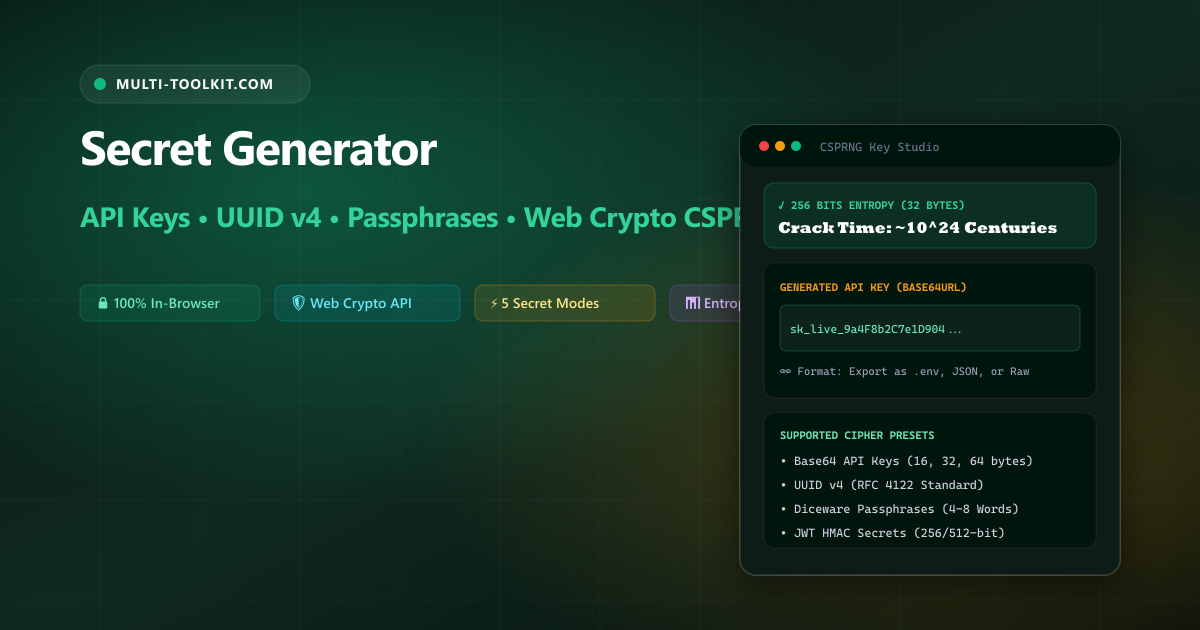
Generate cryptographically secure API keys, UUIDs, Diceware passphrases, and passwords in seconds: leverage OS hardware entropy, evaluate brute-force resistance with a live entropy meter, and export config-ready keys 100% in your browser.
In modern application development, security architectures rely on cryptographically unguessable random values. Whether generating Stripe-style live API keys (sk_live_...), database primary keys, JWT HMAC signing secrets, or master infrastructure passwords, the mathematical randomness of your keys represents the first and most critical line of defense.
Despite this importance, many developers and IT administrators still use risky generation practices:
- The
Math.random()Fallacy: Standard JavaScriptMath.random()is a pseudo-random number generator (PRNG) using deterministic algorithms. If an attacker observes a few generated values, they can compute the internal state and predict future keys with mathematical certainty. - Cloud Generator Exposure: Using cloud-hosted password generators sends your brand-new credentials across the public internet, exposing them to server logs, proxy intermediaries, and browser extensions.
- Low Entropy Keys: Short or predictable passwords without sufficient character variety can be cracked in seconds by modern GPU clusters using parallelized brute-force dictionaries.
The Multi-Toolkit Secret Generator provides an uncompromising cryptographic key studio running strictly in client-side RAM.
Cryptographic secret generation comparison
Compare how Multi-Toolkit delivers verified OS kernel entropy and multi-format exports compared to alternatives:
| Feature & Capability | Multi-Toolkit Secret Studio | Generic Cloud Generators | Math.random() Scripts |
|---|---|---|---|
| Entropy Source | OS Kernel Pool (Web Crypto CSPRNG) | Unknown remote server script | Deterministic pseudo-random |
| Cryptographic Grade | NIST SP 800-90A Compliant | Unverified | Insecure for credentials |
| Generation Modes | Base64, UUID v4, Diceware, JWT, Passwords | Single password box | Custom code required |
| Entropy Meter | Exact Shannon bits & crack time estimate | Basic weak/strong bar | None |
| Bulk Batch Mode | Generate up to 50 keys at once | Single output only | Loop required |
| Privacy & Telemetry | 100% In-Browser (0 network calls) | Transmitted over HTTP | Local only |
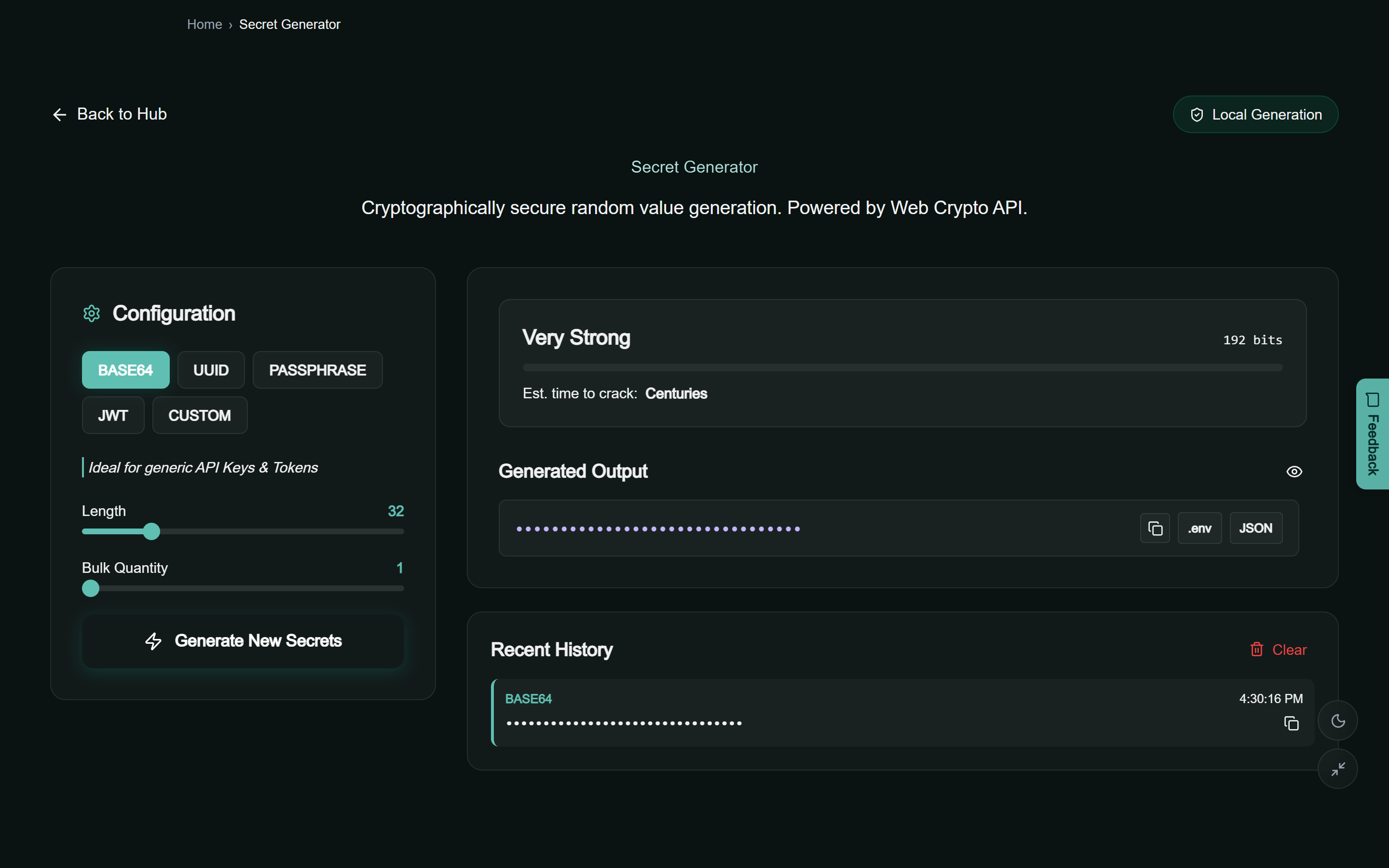
Dual interface: clean visual key studio & entropy meter
The tool provides a streamlined dual-theme interface designed for rapid single and bulk generation, mode selection, and real-time entropy calculation:
Technical deep dive: Web Crypto API & Shannon entropy
Understanding how true cryptographic randomness is generated and measured ensures your applications remain impenetrable:
1. The Web Crypto CSPRNG architecture
Rather than using deterministic algorithms, Multi-Toolkit calls window.crypto.getRandomValues(new Uint8Array(n)). This browser API interfaces directly with the host operating system’s physical entropy pool:
- Linux & macOS: Gathers environmental noise from
/dev/urandom(device drivers, thermal sensors, disk I/O interrupt timings). - Windows: Interfaces with
BCryptGenRandomthrough the Windows Cryptography Next Generation (CNG) kernel subsystem. - Mobile Devices: Utilizes the hardware Secure Enclave True Random Number Generator (TRNG).
2. Shannon entropy & brute-force mathematics
Key strength is calculated in bits of Shannon entropy:
Entropy (bits) = Length × log2(Character Pool Size)Consider the brute-force search space across common key specifications:
- 128 bits of entropy (16 bytes): Approximately 3.4 × 1038 possible combinations. A cluster of supercomputers testing 100 trillion guesses per second would require over 1017 years to brute-force.
- 256 bits of entropy (32 bytes): The military-grade gold standard for AES-256 master keys and API root secrets, providing complete resistance against both classical and theoretical quantum brute-force attacks.
3-step workflow: generating production keys
Follow this 3-step workflow to generate and export cryptographic keys in seconds:
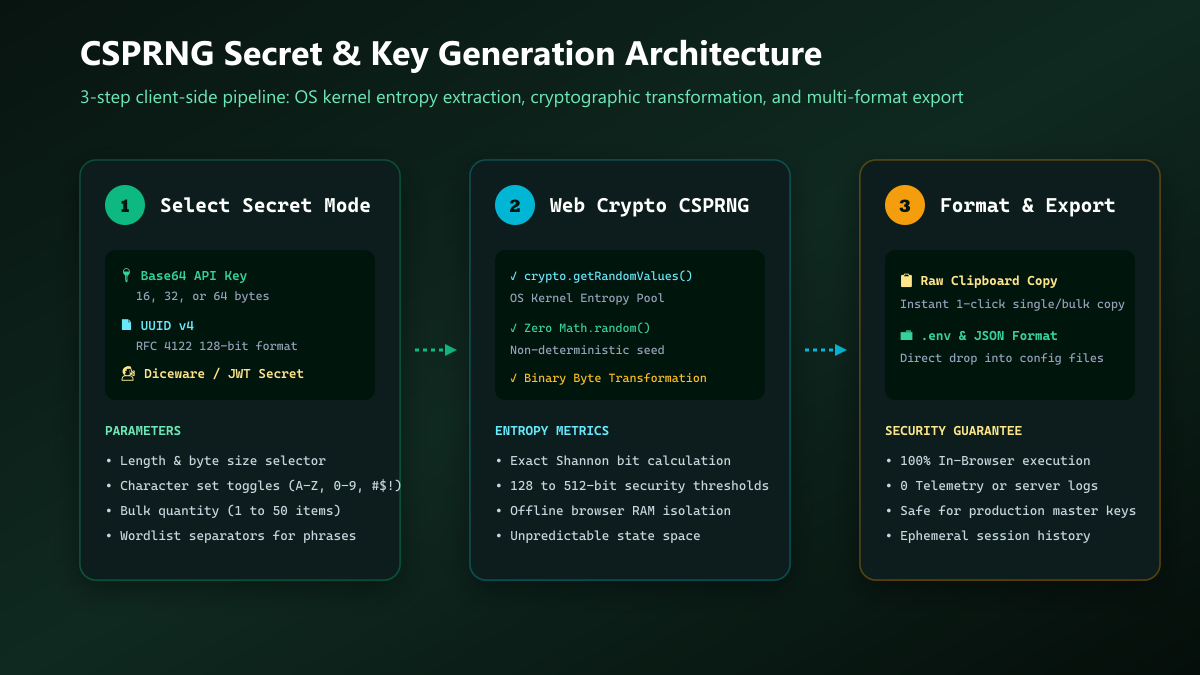
- Select Generation Mode: Open the Secret Generator and pick your desired format: Base64 API Key, UUID v4, Diceware Passphrase, JWT Secret, or Custom Password.
- Configure Parameters & Quantity: Set byte length (e.g. 32 bytes for 256 bits), word count, or character sets. Choose single mode or generate up to 50 items in bulk.
- Review Entropy & Export: Verify the live Shannon entropy meter and crack time estimate. Copy the secret directly or export formatted
.envvariables or JSON arrays.
The 5 specialized generation modes
Different engineering use cases require distinct secret formats. Multi-Toolkit provides five native generation engines:
1. Base64 cryptographic API keys
Generates raw binary random bytes encoded in standard or URL-safe Base64. Ideal for Stripe-style access tokens (sk_live_...), webhook signing secrets, and session cookies.
2. UUID v4 identifiers
Produces 128-bit RFC 4122 compliant identifiers (xxxxxxxx-xxxx-4xxx-yxxx-xxxxxxxxxxxx) designed for database primary keys and distributed idempotency tokens.
3. Diceware passphrases
Generates memorable 4 to 8-word phrases joined by hyphens (e.g. correct-horse-battery-staple-auth) using curated wordlists, delivering over 80 bits of true entropy that humans can easily type.
4. JWT HMAC secrets
Generates 256-bit (32-byte) or 512-bit (64-byte) Base64URL strings optimized for symmetric token signing (HS256 / HS512).
5. Custom password engine
Provides granular control over password length (8 to 128 characters) and toggles for uppercase letters, lowercase letters, numbers, and symbols, with options to exclude ambiguous characters (0, O, l, 1).
Common secret generation mistakes & best practices
| Common Mistake | Security Vulnerability | Safe Best Practice |
|---|---|---|
Using Math.random() | Deterministic output allows attackers to predict future keys | Always use crypto.getRandomValues() |
| Short HMAC secrets (< 256 bits) | Vulnerable to offline GPU dictionary attacks | Use minimum 32 bytes (256 bits) for HS256 |
| Generating keys on cloud websites | Exposes new credentials to server logs and CDN edges | Use 100% in-browser client-side generators |
| Committing secrets to Git | Hardcoded credentials leaked in repository history | Export as .env and load via environment variables |
100% in-browser privacy & zero-telemetry guarantee
Production secrets and master keys require absolute confidentiality. Multi-Toolkit enforces strict client-side isolation:
- Local In-Memory Generation: All random byte generation and encoding happen strictly in client-side browser RAM.
- Zero Data Telemetry: No generated keys, passphrases, or configuration options are transmitted across the network or logged on any server.
- Air-Gapped Compatibility: Works completely offline without internet connectivity.
Frequently asked questions
What makes a secret cryptographically secure?
A secret is cryptographically secure when it is generated using a cryptographically secure pseudorandom number generator (CSPRNG). This tool uses the Web Crypto API’s crypto.getRandomValues() function, which sources entropy directly from the host operating system kernel rather than predictable math functions.
What is the difference between Base64, UUID, and passphrase modes?
Base64 mode generates raw random bytes encoded as text—ideal for API keys and encryption secrets. UUID v4 generates 128-bit RFC 4122 identifiers for database records. Passphrase mode generates memorable multi-word combinations. JWT mode generates Base64URL secrets for HMAC token signing.
How much entropy do I need for an API key?
For production API keys and authentication tokens, aim for at least 128 bits of entropy (16 bytes). For master database encryption keys and root secrets, 256 bits (32 bytes) is the industry gold standard.
Is it safe to generate passwords in a web browser?
Yes. Because Multi-Toolkit executes 100% locally on the client side using the Web Crypto API, generated passwords and keys never travel across the internet or touch any server.
Can I generate multiple keys at once?
Yes. Set the quantity slider up to 50 to generate a batch of secrets. You can copy the entire batch with one click as raw lines, .env environment variables, or a JSON array.
Are my generated secrets stored anywhere?
No. All generation is strictly ephemeral and exists only in your browser tab RAM. Nothing is stored in databases, cookies, or remote server logs.
Generate cryptographically secure secrets in seconds
Create API keys, UUIDs, Diceware passphrases, and passwords with verified OS kernel entropy and 100% in-browser privacy.
Open Free Secret Generator →