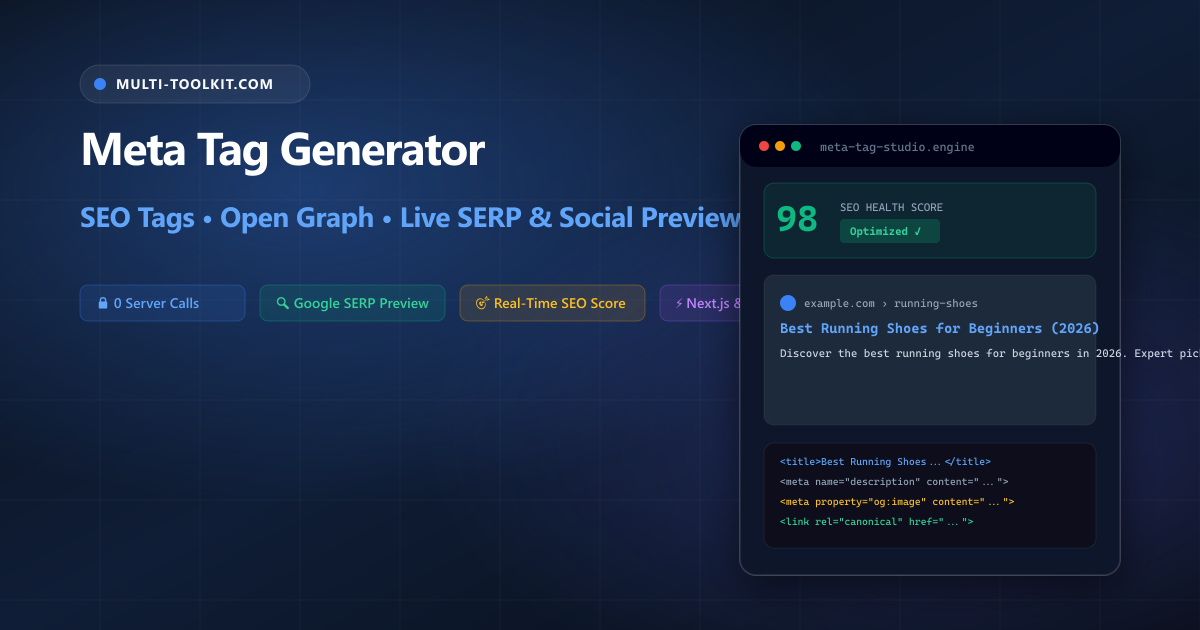
Craft production-ready SEO metadata and social preview cards: simulate Google SERP results, audit tag health scores in real time, and export native Next.js and React snippets 100% in your browser.
Every time a search bot crawls your website or a user shares your link on social media, your HTML document’s <head> tags dictate how your content is perceived. A well-optimized title and description increase organic impressions into clicks, while properly configured Open Graph (OG) tags and Twitter/X Cards ensure full-width visual preview banners instead of unformatted text links.
Yet web developers and SEO marketers regularly face frustrating metadata challenges:
- Pixel Truncation on Search Engines: Google measures search snippets in pixels (~600px for desktop titles, ~960px for descriptions) rather than character counts. Without a visual SERP preview, key branding and call-to-actions get abruptly truncated.
- Broken Social Previews: Missing
og:imagedeclarations, incorrect aspect ratios (deviating from 1200×630), or unconfigured Twitter Card tags cause links to display as blank gray boxes on Facebook, LinkedIn, Discord, and Slack. - Framework Formatting Overhead: Modern web stacks (such as Next.js 14/15 App Router, React Helmet, and Nuxt) require nested JavaScript configuration objects rather than raw HTML markup.
The Multi-Toolkit Meta Tag Generator provides an instant, comprehensive, and completely private metadata studio running locally in client-side memory.
The core meta tag taxonomy for modern web apps
Modern web pages require three distinct layers of metadata embedded in the document head:
| Category | Key Tags & Directives | Optimal Specification | Primary Impact |
|---|---|---|---|
| Search Engine SEO | <title>, description, canonical, robots | Title: 50–60 chars; Desc: 120–155 chars | Google ranking relevance & SERP CTR |
| Open Graph (OG) | og:title, og:description, og:image, og:url | Image: 1200 × 630 px (1.91:1 ratio) | Facebook, LinkedIn, Discord & Slack rich cards |
| Twitter / X Cards | twitter:card, twitter:site, twitter:image | summary_large_image layout | Full-width media banner previews on X feed |
Dual interface & real-time visual simulation
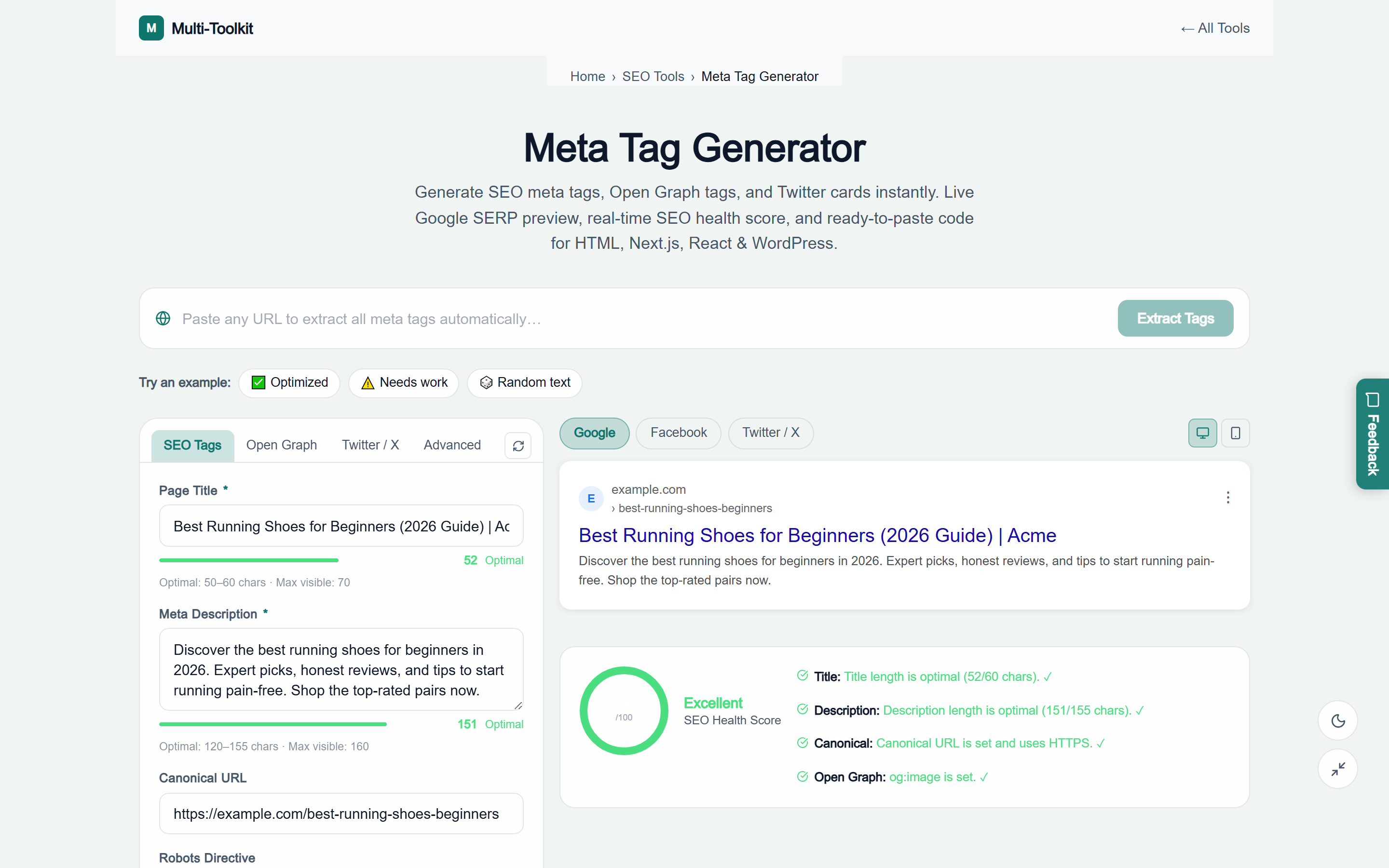
Explore the clean dual-theme interface featuring live SERP simulation, SEO score audit, and multi-framework code export:
Real-time SEO health score & heuristic auditing
The built-in audit engine dynamically scores your metadata from 0 to 100 based on search engine and social graph best practices:
- Title Length Validator: Confirms title is between 50 and 60 characters (~600px width). Flags short titles (<30 chars) and over-length titles (>70 chars).
- Description Boundary Check: Ensures descriptions sit within the optimal 120–155 character sweet spot for full SERP snippet visibility without mobile truncation.
- Action & Power Words Detection: Scans for high-converting call-to-action verbs (Discover, Learn, Explore, Get, Try, Save) and authoritative terms (Ultimate, Essential, Proven, Complete).
- Canonical URL Security: Verifies that canonical URLs use secure HTTPS protocols and correct domain structure.
- Social Graph Completeness: Validates the presence of
og:image,og:type, andtwitter:carddeclarations.
Multi-framework code generation
The generator exports ready-to-paste snippets tailored to your application’s tech stack:
Next.js 14/15 App Router (TypeScript / JavaScript)
import type { Metadata } from 'next';

export const metadata: Metadata = {
  title: 'Best Running Shoes for Beginners (2026 Guide) | Acme',
  description: 'Discover the best running shoes for beginners in 2026. Expert picks, honest reviews, and tips to start running pain-free.',
  alternates: {
    canonical: 'https://example.com/best-running-shoes-beginners',
  },
  openGraph: {
    title: 'Best Running Shoes for Beginners (2026 Guide) | Acme',
    description: 'Discover the best running shoes for beginners in 2026.',
    url: 'https://example.com/best-running-shoes-beginners',
    siteName: 'Acme',
    images: [{ url: 'https://example.com/images/og-banner.jpg', width: 1200, height: 630 }],
    type: 'article',
  },
  twitter: {
    card: 'summary_large_image',
    title: 'Best Running Shoes for Beginners (2026 Guide) | Acme',
    description: 'Discover the best running shoes for beginners in 2026.',
    images: ['https://example.com/images/og-banner.jpg'],
  },
};
Raw HTML5 <head> Snippet
<!-- Primary SEO Meta Tags -->
<title>Best Running Shoes for Beginners (2026 Guide) | Acme</title>
<meta name="title" content="Best Running Shoes for Beginners (2026 Guide) | Acme">
<meta name="description" content="Discover the best running shoes for beginners in 2026. Expert picks, honest reviews, and tips to start running pain-free.">
<link rel="canonical" href="https://example.com/best-running-shoes-beginners">
<meta name="robots" content="index, follow">

<!-- Open Graph / Social Media -->
<meta property="og:type" content="article">
<meta property="og:url" content="https://example.com/best-running-shoes-beginners">
<meta property="og:title" content="Best Running Shoes for Beginners (2026 Guide) | Acme">
<meta property="og:description" content="Discover the best running shoes for beginners in 2026.">
<meta property="og:image" content="https://example.com/images/og-banner.jpg">

<!-- Twitter Cards -->
<meta name="twitter:card" content="summary_large_image">
<meta name="twitter:url" content="https://example.com/best-running-shoes-beginners">
<meta name="twitter:title" content="Best Running Shoes for Beginners (2026 Guide) | Acme">
<meta name="twitter:description" content="Discover the best running shoes for beginners in 2026.">
<meta name="twitter:image" content="https://example.com/images/og-banner.jpg">
How to generate and audit meta tags (3 simple steps)
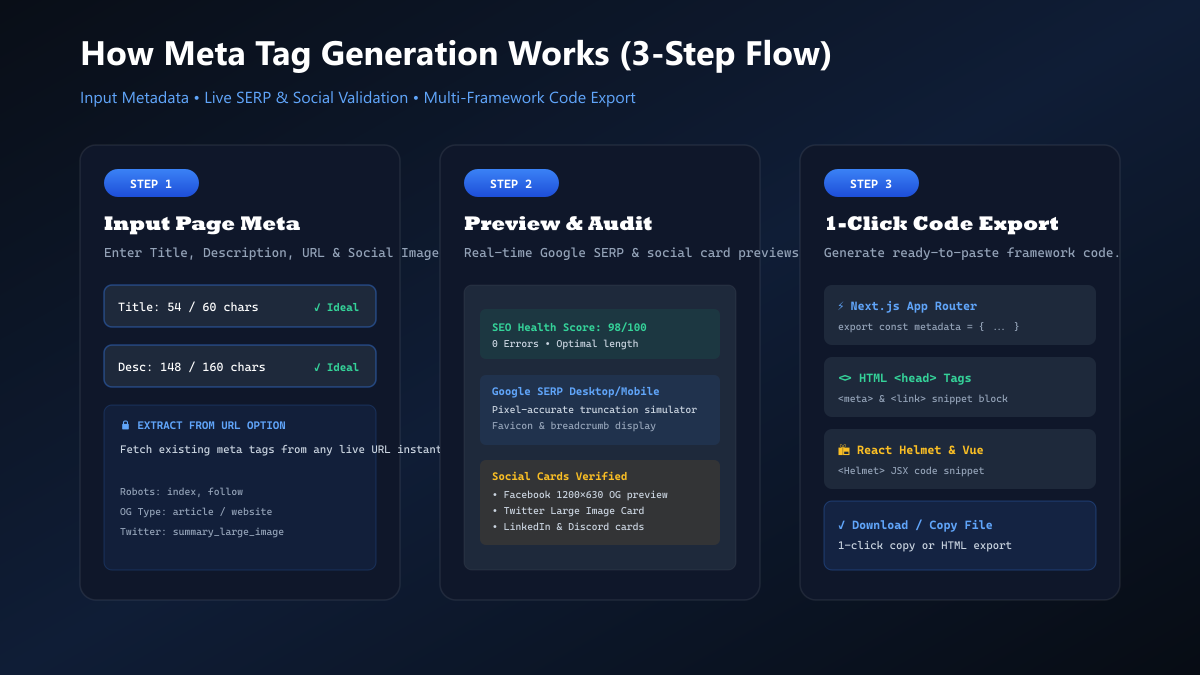
- Input Page Details: Type your Page Title, Meta Description, Canonical URL, and Social Image link. Alternatively, click Extract from URL to import and audit an existing webpage.
- Check Live Previews & Score: Verify how your snippet renders on Google Search (Desktop & Mobile), Facebook, and Twitter. Review the SEO score recommendations to fix truncation.
- Copy Framework Code: Select your framework tab (HTML, Next.js, React Helmet, WordPress) and copy the generated snippet directly into your project.
Comparison: Multi-Toolkit vs basic meta tag generators
| Feature | Multi-Toolkit | Generic Online Generators | Basic Code Snippet Sites |
|---|---|---|---|
| Live Google SERP Simulator | Desktop & Mobile tabs | Basic static preview | No |
| Real-Time SEO Health Score | 0–100 with actionable tips | No | No |
| Next.js App Router Export | Native Metadata object | Raw HTML only | Manual copy-paste |
| Live URL Meta Extractor | Included free | Paid subscription | No |
| Privacy & Telemetry | 100% In-Browser (0 Telemetry) | Ad trackers & cookies | Ad-heavy |
Frequently asked questions (FAQ)
What is the optimal length for an SEO title tag?
Google displays title tags up to approximately 600 pixels wide, corresponding to 50–60 characters. Aiming for 50–60 characters ensures full visibility without unexpected ellipsis cutoff.
How long should a meta description be?
Search engines display meta descriptions up to 960 pixels on desktop (~155–160 characters) and slightly less on mobile. The ideal length is 120–155 characters with a compelling call-to-action.
What is the recommended size for Open Graph images?
The recommended standard for Open Graph images (og:image) is 1200 × 630 pixels (a 1.91:1 aspect ratio), ensuring sharp previews on Facebook, LinkedIn, Discord, and Twitter/X.
How does the tool calculate the SEO health score?
The real-time score (0–100) evaluates title length, description boundary limits, inclusion of action verbs, canonical HTTPS formatting, Open Graph image presence, Twitter card declarations, and gibberish detection.
Does the generator support Next.js App Router metadata?
Yes. In addition to standard HTML5 head tags, the tool exports native Next.js App Router metadata objects, React Helmet JSX, Nuxt/Vue useHead snippets, and WordPress PHP hooks.
Are my drafted meta tags private?
Yes. All tag generation, live SERP simulations, and validation checks run 100% locally in your web browser memory with zero server telemetry.
Explore related SEO & developer tools
- Robots.txt Generator — Create customized search crawler directives and sitemap declarations.
- Link Checker — Audit broken links and redirect chains across your website.
- URL Encoder / Decoder — Encode and decode RFC 3986 URI components safely.
- Base64 Encoder — Encode and decode text, tokens, and data URIs in-browser.
- Word Counter — Real-time word, character, and sentence analytics for copywriters.
Generate, audit, and export production-ready meta tags with live SERP previews:
Open Free Meta Tag Generator →